You've got a friend in me: What does research have to do with relationships?
Stephanie Acker, Andrew Geddes, and Negar Katirai explore the importance of relationships in research and the benefits of participatory research, which are key aspects of U-Lead, a youth leadership and participatory research programme.



Reading time: 7 min.
The world’s longest-running study of adult development—the Harvard Study that began in 1938—followed more than 700 young people over their lifetimes. Its core finding, in the words of the study’s current directors Robert Waldinger and Marc Schulz, is simple: “Good relationships keep us healthier and happier. Period.”
If research shows that relationships are the most central element to human flourishing, what might that mean for the EUI as a research institution and what impact might it have on how we do research today?
In this EUIdeas piece, we share how we’ve grappled with this at the EUI’s Migration Policy Centre (MPC) and how it led to the development of a research programme called U-Lead that focuses on young people – including unaccompanied migrant minors – and fosters relationships, empathy, and civic participation.
Rethinking research
In migration studies there is a familiar pattern: a relatively small number of institutions—mostly in high-income countries—produce the bulk of migration research. This disparity means that people with lived experience of migration are often seen as research subjects who are interviewed, observed, and even measured, but not as partners or authors. This raises deeper issues: Who gets to ask the questions? Who interprets the answers? And who decides what counts as knowledge? These questions are not just academic debates, but also about voice, dignity, and belonging.
At the Migration Policy Centre, we wanted to respond to these questions in a tangible way. Therefore, the MPC partnered with UNICEF’s Europe and Central Asia Regional Office to launch a local initiative to explore the most urgent issues facing young people from migrant and refugee backgrounds in Florence, where the MPC is located. Over several months, we met with schools, NGOs, reception centres, and local authorities. Across these local consultations, three issues repeatedly came up that are also common for young migrants across Italy: access to education, preparation and access to the labour market, and civic participation.
While we were learning a lot about challenges young migrants were experiencing, something was still missing: We had answers from adults about questions posed by adults, but no perspectives from youth directly.
That realisation prompted a shift. Instead of continuing to conduct research about youth, what if instead created a space for youth to do research themselves? This led us to participatory research, a model that treats people from outside traditional academic settings as co-researchers. It starts not with a ready-made hypothesis, but with listening. It invites people to help shape the research process: defining the focus, choosing the methods, collecting the data, and interpreting the results.
It’s slower. Sometimes messier. But it’s also more grounded, more relevant, and, often, more transformative for everyone involved. From this shift, U-Lead was born.
U-Lead in practice
U-Lead is a youth leadership and participatory research programme. It brings together three groups: local high school students; unaccompanied migrant minors, and EUI staff; researchers, and students from the EUI and the University of Florence. It emerged from a desire to create a space where young people from radically different walks of life could meet, learn from each other, and develop research-based civic proposals. By bringing together these three groups, U-Lead creates a rare and meaningful space for relationships to form.
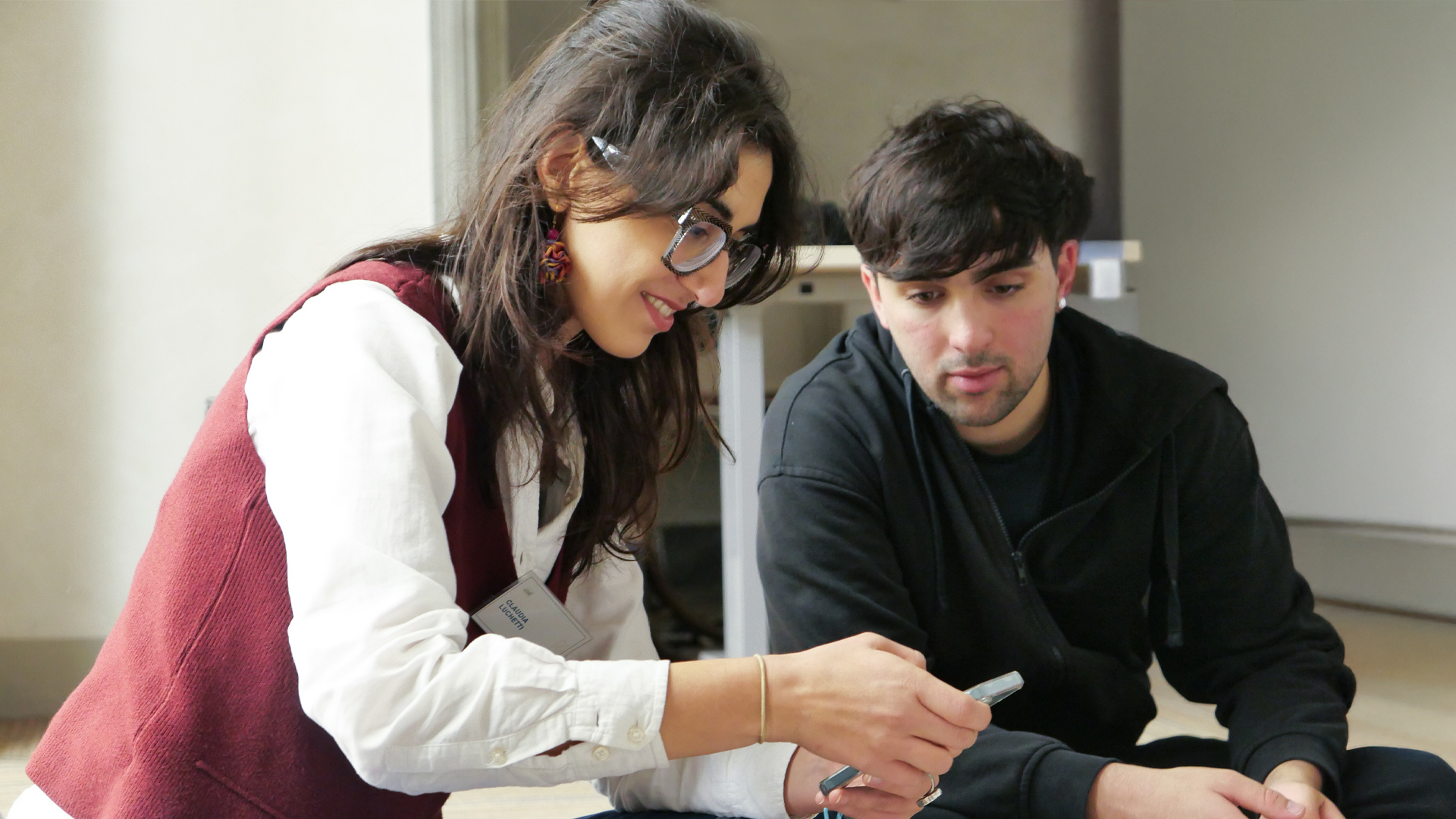
Participants are placed in teams of 5-6 young people supported by two mentors: a Research Coach, who provides academic guidance, and a Youth Coach, who brings lived experience and cultural expertise. During a week-long pilot in June 2025 and then again over 12 weeks in autumn 2025, more than 40 participants met at the EUI’s Robert Schuman Centre, not as research subjects but as researchers. They learn about their rights as codified in the UN Convention of Child Rights, choose a right that matters to them, design and conduct research, collect data, and then present their findings to city officials and stakeholders at a closing ceremony at the EUI.
During the June 2025 pilot, one youth research team focused on a critical but often overlooked issue: the struggle to obtain legal documents. Through interviews with migrant peers and foreign students at the EUI, the team uncovered how delays in receiving residence permits affected every part of life—from finding work and housing to accessing healthcare and education.
One participant summarised the problem starkly: : “You wait months, sometimes years, for an appointment. And while you wait, your life is on hold.” Another added: “Someone told us, ‘If I’m good, they treat me well.’ That made us stop. Because rights shouldn’t depend on being ‘good’. Rights should be for everyone.”
But their work didn’t stop at diagnosis. The team proposed practical solutions—from more cultural mediators to improved websites and better staff training for personnel of the Questura (the Questure being the provincial police headquarters in Italy)—offering a clear vision for a more dignified and inclusive system.
This is what U-Lead makes possible: youth-led research that not only exposes urgent problems, but proposes real, local solutions through a model that can be replicated in other cities facing the same challenges.
Research, relationships, or both?
Psychology and youth development research consistently affirms the power of connection.
Adolescents with strong social capital (trusting relationships, community ties, and a sense of belonging) report better health and mental health, and more positive identity formation. Even brief but meaningful intergroup contact can significantly reduce prejudice and increase empathy across lines of difference, a critical insight for cities navigating diverse populations and polarisation of views from different groups.
Adolescence and young adulthood are pivotal developmental windows. It’s a time when young people are looking for purpose and when identity, agency, and belonging are being formed. Research suggests that experiences during this period significantly influence one’s long-term civic trajectory, including attitudes toward difference, participation in democracy, and engagement in public life. But many young people today, especially migrants and refugees, are navigating this transition in isolation or have never been given a chance to imagine how their life and experience could contribute to their local community.
Young people who take part in participatory research gain confidence, feel more motivated to make a difference, and get more involved in their schools and communities.
The benefits of the participatory approach are not only for youth.
For researchers and institutions, programmes like U-Lead offer a deeper, more grounded way of producing knowledge. They challenge adult researchers to move beyond extractive models of “studying” lived experience, and instead treat lived experience as a form of expertise in its own right. Participatory approaches widen the lens of what counts as evidence, and often surface insights that would be impossible to reach through traditional methods alone. In doing so, they strengthen the relevance, impact, and ethical foundations of research itself.
U-Lead creates a place to be curious, to be heard, and to contribute. A place where young people can lead. Where young people can help define what belonging means within their communities. And perhaps most importantly, it’s a place where youth get to see how their own stories matter.
As one participant from the autumn programme shared: “The most difficult part was during the first days, leaving my zone of comfort, meeting people who have experienced difficulty (...) Thanks to U-Lead I have the desire to wake up early because I felt heard and supported by the coaches, we all felt at the same level."
Expanding the circle of friends
If the longest-running study on human happiness teaches us that relationships matter most, then participatory action research offers a promising way to foster relationships and complement the staples of research —robust research design and peer-reviewed publications—that we already have. But starting with a conversation, a neighbourhood walk, or a circle of young people sharing stories can add something valuable: connection. And that connection can deepen not just our understanding of the data, but our understanding of each other.
Tags: relationships, participatory research, youth, Migration