Why do international organisations make poor scapegoats for politicians?
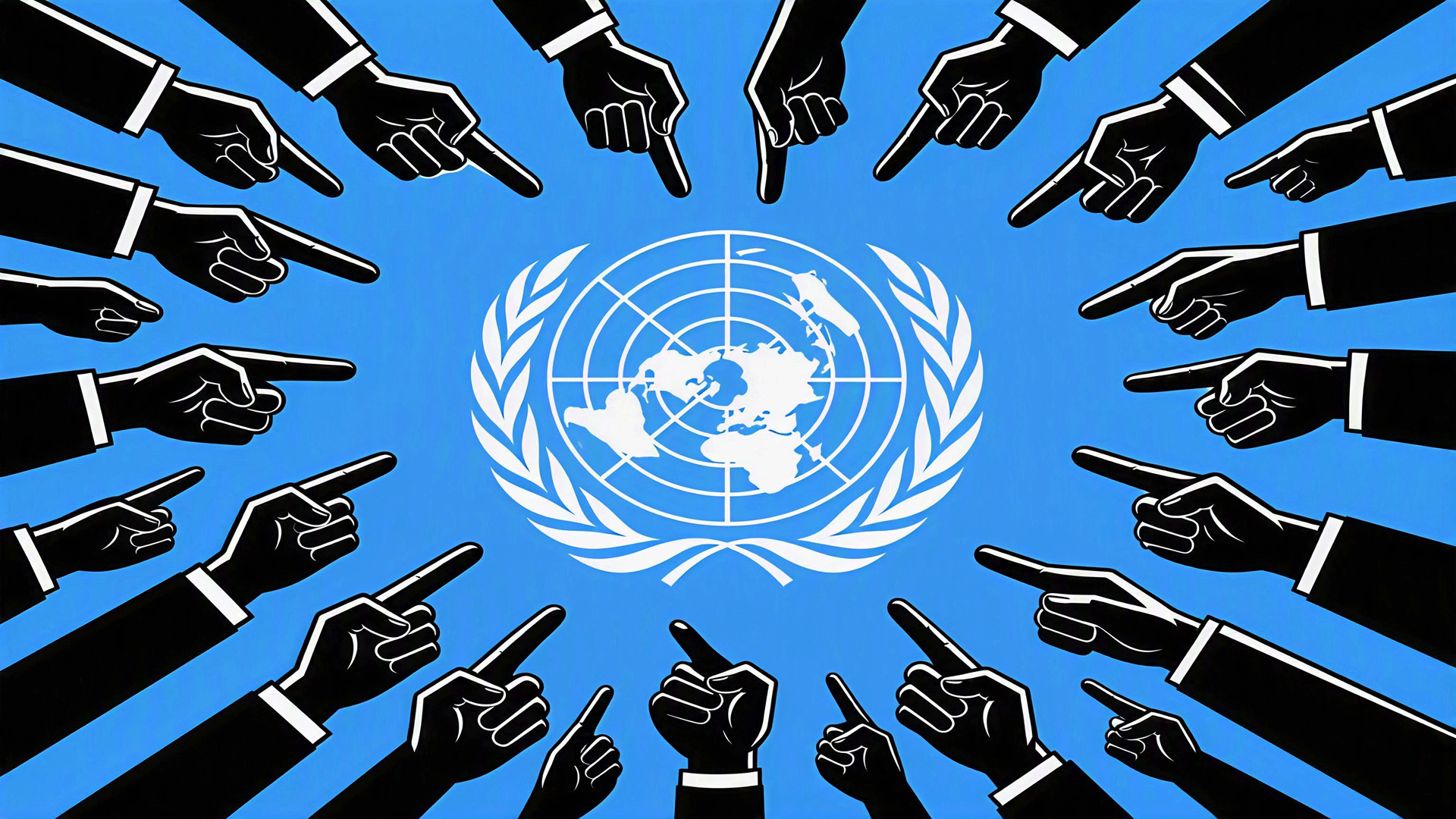
Shifting blame onto international organisations for negative outcomes is generally expected to be a common strategy of national politicians. But research reveals that leaders use this tactic far less often — and far less successfully — than we think.
Author:

Reading time: 6 min.
President Donald Trump has publicly denounced the International Criminal Court (ICC) for engaging in “illegitimate and baseless actions” against the US and its ally Israel, following the court’s investigations into Israeli Prime Minister Benjamin Netanyahu for war crimes and crimes against humanity. When Trump needed a scapegoat for the impact of COVID-19, he turned to the World Health Organisation (WHO), accusing it of “severely mismanaging and covering up” the outbreak of the pandemic. Politicians are often said to engage in finger-pointing at international organisations (IOs) to avoid blame for policies or crises that negatively affect their constituencies. For example, austerity measures are pinned on the International Monetary Fund (IMF); the World Trade Organisation (WTO) is accused of intruding on domestic labour and environmental laws; and the European Union (EU) is blamed, for instance, for being too weak on issues like migration and too strong in other areas, such as data protection regulations.
IOs are perfect targets for governments to avoid blame, at least according to conventional wisdom in political science. They can be easily portrayed as distant, technocratic bureaucracies and typically lack the communications capacity to fight back. In a series of recent studies, my co-authors and I investigated this claim.
The overarching finding is that national politicians are blaming IOs less frequently than commonly expected. Moreover, when they do, they are often ineffective at shifting public opinion because of their own direct involvement in IO policymaking and implementation. By contrast, citizens even reward their national leaders for taking ownership of contested IO policies. There is thus reason for hope regarding political accountability, even amid surging populism and growing contestation of IOs.
Governments don’t just shift responsibility: they also take it
Not all politicians follow Trump’s playbook when under pressure. When the global financial crisis hit Greece, Prime Minister George Papandreou had to enact harmful austerity measures. He could have blamed the IMF for the strict conditions attached to the bailout. Instead, he defended the Fund and took responsibility for the economic policies. Our study of more than 800 public statements about the IMF by 16 heads of government across seven major borrower countries over 25 years found that leaders defended the Fund more often than they blamed it. My co-authors Tom Hunter, Sujeong Shim, and I identified only 93 instances of blame-shifting, compared with 319 defences of the Fund.
The IMF is not exceptional in this regard. Analysing European press coverage of ten contested EU policies — from asylum to emissions trading to foreign affairs — revealed that EU institutions are not always the “culprit” either. Lisa Kriegmair, Berthold Rittberger, Bernhard Zangl, and I found that European blame games vary. Blame can focus not only on specific institutions, such as the European Commission or Frontex (the European Border and Coast Guard Agency), but also on individual member states. In other cases, blame is untargeted and diffuse, focusing on no specific actors but rather on ‘Brussels’ or ‘the system.’
Clear responsibilities and credibility risks stop governments from shifting blame
If international organisations are indeed convenient targets, why should governments show restraint in blaming them and accept responsibility themselves? Because blaming rarely works. In Pakistan, during a deeply unpopular IMF programme, Rodwan Abouharb, Bernhard Reinsberg, and I tested whether scapegoating would work in this almost textbook case. No message blaming the IMF changed citizens’ views on who was responsible for harmful economic reforms, whether that message came from the government or from societal actors. Blaming ‘Brussels’ also did not alter German and Dutch citizens’ positions on contested EU policies — from immigration to the environment to digital privacy — in a joint study with Asya Zhelyazkova, Thijs Lindner, and Agnieszka Kanas. The impact on public opinion was stronger when governments defended contested policies and took responsibility for them, stressing that enacting these policies was their duty and framing them as the right thing to do for their citizens.
A key reason for these findings is credibility. If an IO decision is contested domestically, the responsibility of the actors who gave rise to the negative outcome is revealed in the public debate. If a government has, for instance, been instrumental in negotiating an EU policy or signing an IMF lending agreement, it cannot convincingly pose as a bystander. Many voters can see through these efforts. Blaming IOs works better for actors genuinely removed from a decision, such as local authorities not involved in IO negotiations, or for less salient topics that few citizens follow. When policies become publicly contested, taking responsibility and showing responsiveness are more credible strategies. Politicians who still try to scapegoat IOs under these circumstances will not only appear untrustworthy in the eyes of their voters but might also face pushback on the international stage. For instance, when former Prime Minister Alexis Tsipras took office in Greece, he denounced the IMF and put the bailout programme to a referendum; consequently, investors took fright, and Greek borrowing costs more than doubled.
Building trust and accountability: why governments must take and streamline responsibility
IOs are not convenient scapegoats for national governments. Voters appear to be less credulous than often feared, and institutional responsibilities, as long as they are clearly organised, prove sticky. When leaders who are genuinely responsible for a policy have a hard time avoiding responsibility by shifting blame onto IOs, blame games can ultimately contribute to political accountability.
While I would love to end on this optimistic note, I must do so with a grain of salt. Blame games often do not hit the wrong actors, but sometimes, they do not focus on specific actors at all. When supranational and intergovernmental bodies share decision-making authority with member states — for instance, in areas of co-decision-making in the EU — responsibility is complex. Blame then often spreads across ‘Brussels,’ ‘the member states,’ and ‘the system.’ Moreover, populist leaders like Donald Trump might still choose to attack IOs like the ICC or the WHO; even if their claims ring hollow to a majority of voters, they can still hope to reach groups of ideologically aligned supporters. Both diffuse and non-credible blame risk eroding public trust in domestic and international institutions in the long run.
It is crucial that politicians take responsibility, simplify IO decision-making procedures, and defend their policy choices even amid domestic pushback. When owning a policy is more persuasive than distancing oneself from it, defending hard decisions can be both electorally rewarding and democracy-enhancing.