Unexpected inspiration: What Myrdal taught me about the global economy
Erik Jones reflects on how a failed PhD exam and a chance encounter with a second-hand book transformed his thinking about economic integration, globalisation and political institutions—a first-person essay on The Power of Knowledge.
Author:

Reading time: 6 min.
In our exploration of The Power of Knowledge, we asked EUI academics: What is the most powerful piece of knowledge you have encountered, and how has it transformed your research?
Here, the personal story of Erik Jones:
I had to take my PhD comprehensive examination in international economics twice. I was doing my PhD in European Studies at the Johns Hopkins School of Advanced International Studies (SAIS), and my supervisor, David Calleo, insisted that I take international economics as one of my three qualifying exams. That didn’t go so well the first time around. The irony (or humiliation) was that I was teaching assistant for international trade theory and international monetary theory. I just had a hole in international development. It was a six-hour written exam. Isaiah Frank was responsible for the international development part. He was a legend at SAIS. He asked an important question, and I didn’t have a convincing answer. I would have to study a lot – including by going back to the classics from the early postwar period.
Imagine my surprise when, soon after I received the bad news, I walked past an outdoor used book stand that Kramer books had set up at the bottom of Pennsylvania Avenue in Washington to catch summer tourists. It was 1992 and there was no Amazon. There were barely cell phones or email addresses for that matter. I was taking a walk to clear my head from the disappointment over failing the exam and I thought I would look for old books in the stacks on the outdoor table that might help me prepare better.
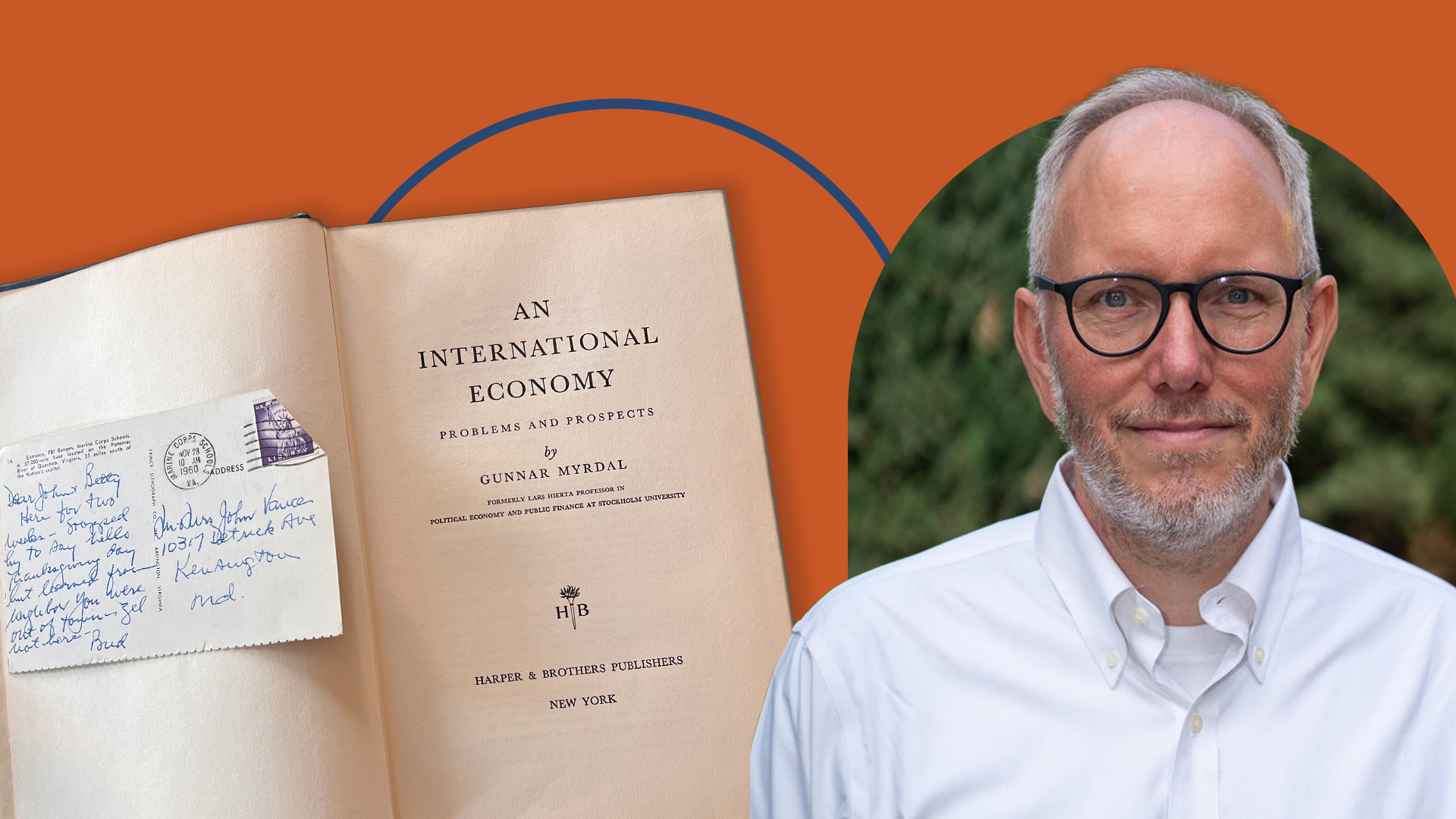
As luck would have it, I found a book by Gunnar Myrdal called An International Economy: Problems and Prospects. Myrdal published the book in 1956. The original (and from what I can tell, only) owner must have bought it and set it on the shelf. I found a postcard inside from 1960 that he or she left as a bookmark somewhere close to be beginning. But I knew Myrdal was a Nobel prize-winning economist. I also remembered vaguely that he worked for a while at the UN and that Professor Frank had mentioned Myrdal’s name alongside Raúl Prebisch. I figured it was worth the $1 Kramer’s was asking, and so I bought it.
What I found inside was unexpected. Myrdal was writing about the challenges of economic development, but that only came toward the end of the book. The first hundred pages were about national integration, international integration, and the tensions that arise between the two. His focus was on the United States and Western Europe. They were also about the possible failure of European integration – remember, this was written before the 1957 Treaty of Rome – and what Europeans could do about it. I don’t think anyone who was studying European integration at the time (or after!) was aware of this book or the arguments Myrdal made. But suddenly, I was hooked.
Myrdal makes three powerful claims:
- First, national governments integrate their economies and societies with a bewildering variety of institutions that fit together in curious ways. Think ‘varieties of capitalism’, only 40 years before the fact.
- Second, when national governments lower barriers to cross-border trade and payments, those institutions they set up to integrate societies and economies domestically have a powerful influence on the relative cost and quality of firms and individuals doing business in other countries. Think about the Letta and Draghi reports and then trace the themes they raise back through the whole line of debates about ‘competitiveness’ and welfare state reform running back to the 1960s.
- Third, this influence of domestic institutions on international competitiveness leaves national governments with an unenviable choice: either they can change their domestic institutions to ensure their global competitiveness at the risk of raising inequality at home – domestic disintegration – or they can withdraw from the international economy and retreat into autarky or spheres of influence – international disintegration.
These three claims tell us an enormous amount about how the world economy works. They tell us why participation in a globalised economy does not make all countries look the same – because the institutions required for national integration are simply too complex, too interconnected, and too politically salient for that kind of convergence to take place. They tell us why large multilateral trade negotiations are unlikely to succeed as they reach too far beyond national borders and into domestic institutions – again, because of the way institutional politics works in the domestic context. Even very close partners will find it difficult to work together. Just think about the failure of the Transatlantic Trade and Investment Partnership immediately prior to the first Trump administration.
Finally, and perhaps most important, Myrdal’s arguments tell us why the globalisation of the world economy is likely to be unstable in the face of both exogenous shocks and endogenous changes at different levels of aggregation – local, regional, national, transnational, global. This last point is a little hard to explain. I first wrote the argument almost immediately after reading Myrdal’s book. That was in the mid-to-late 1990s. After many rounds of revision with many different journals and the contributions of countless graduate students who had to listen to me explain what Myrdal was saying, I finally managed to get the paper published. That was in 2018.
As I look back on my research trajectory over the past three decades, I can see the threads of Myrdal’s argument lying everywhere. His work has informed my understanding of democracy, populism, crisis, and solidarity. It has influenced my thinking on markets, welfare states, and political institutions more generally. It has taught me a lot about why Europe has succeeded in its project, and why that success was such a close-run thing. And it gives me some good reasons to guess where the world economy is headed.
I got all that because I failed a PhD comprehensive examination and decided I had better go back to the classics. And the best part is that there were no ‘international development’ questions on the next version of the economics exam; just Micro-, Macro-, Money, and Trade. If I had those questions the first time around, I never would have picked up Myrdal’s book.
Erik Jones is Director and Professor at the Robert Schuman Centre for Advanced Studies. He is also Non-resident Scholar at Carnegie Europe. Professor Jones’ latest book is a Cambridge ‘element’ written with Veronica Anghel that is available ‘open access’ and is called From Club to Commons: Enlargement, Reform and Sustainability in European Integration (CUP, 2025).
This EUIdeas essay is a contribution to the conversations launched at the EUIdeas flagship event themed The Power of Knowledge, held on the occasion of the EUI’s 50th anniversary. The initiative is aimed at reimagining Europe by showing how universities can deploy knowledge to illuminate challenges, inform public debate, and contribute intellectually to the future of our societies.