The sky is (not) the limit: the case for space regulation
As the space sector shifts from government-led programmes to a private industry, how do we ensure competition and security? Leonardo Meeus explores the need for evidence-based space regulation and the role of the EUI in this new frontier.
Author:

Reading time: 6 min.
Matthew Weinzierl and Brendan Rosseau, in their book Space to Grow, describe how the space sector is undergoing a historic transformation. What was once the exclusive domain of government-led programmes is now becoming a competitive industry where private companies increasingly compete to build the infrastructure of the future. From launch pads to rockets, satellites, and their related services, private companies are increasingly driving innovation in the space sector.
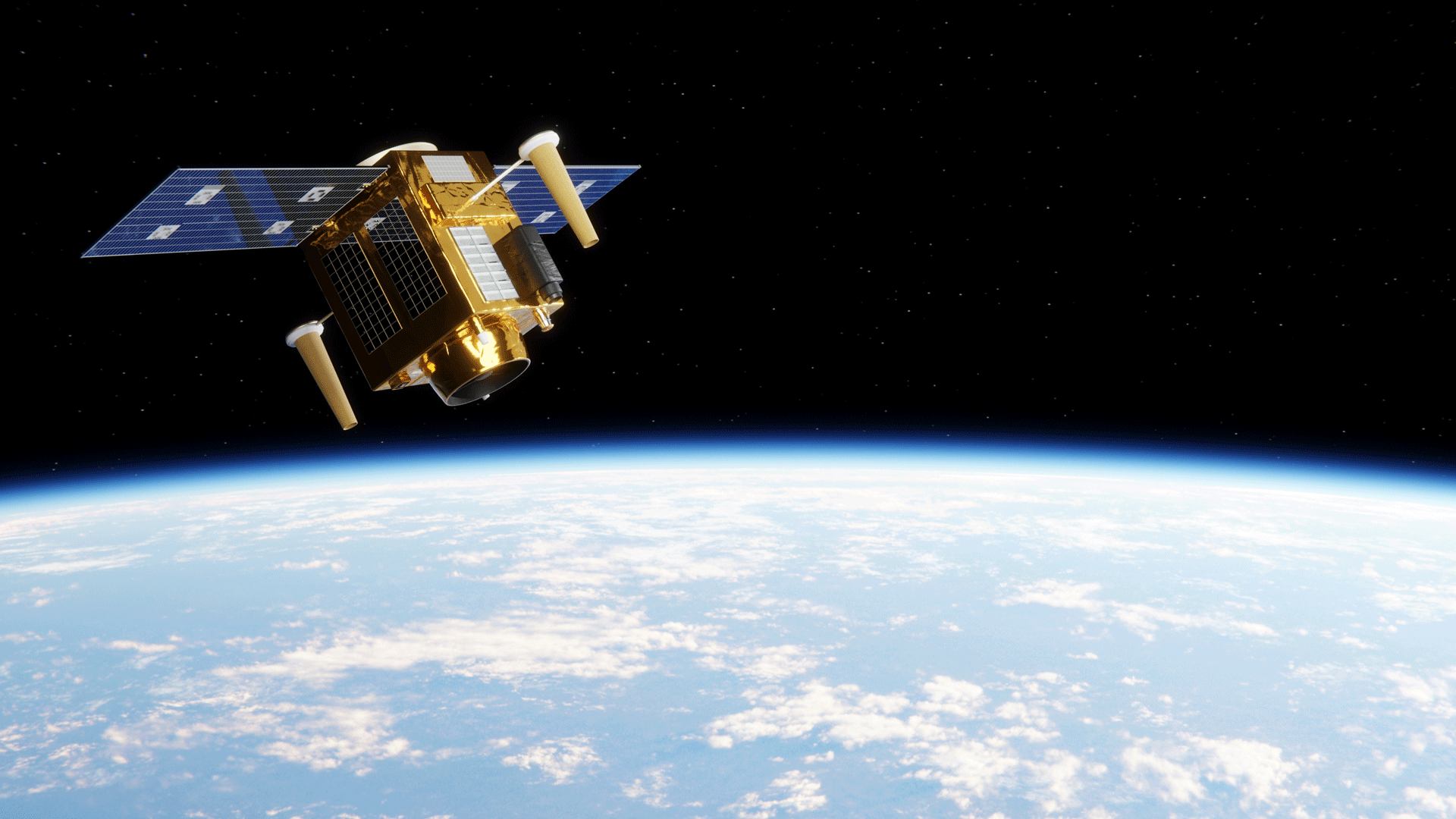
A network of satellites nowadays enables a wide variety of communication, observation, and navigation services. While some of these services still rely on government support, others are increasingly being commercialised. An example of the former is the European Copernicus Earth Observation Programme. Copernicus provides free data access to scientists, businesses, and citizens. The data is used for security, emergency management, and monitoring of land, marine, atmosphere, and climate change. An example of the latter is Starlink by SpaceX, an internet service provided to more than 10M subscribers with more than 10k satellites.
The policy vision by the European Space Policy Institute (ESPI) illustrates how satellite services enhance the productivity, security, and sustainability of the economy on Earth. Applications range from urban planning (e.g. by detecting heat loss of buildings in a city, which can help to plan energy efficiency measures) to taxation (e.g. by estimating total floor space of a building and combining that data with spatial information and land price data), and the management of our critical infrastructure on Earth (e.g. by monitoring growth of vegetation in the vicinity of power lines).
Looking ahead, economic developments in space might include data centres rotating around the Earth powered by solar energy, and mining of asteroids, moons, and planets for critical raw materials and to refuel for space travel. Humankind might live in space or settle on the moon or Mars.
Space and security
Space is also a critical frontier for national security. The Starlink service by Elon Musk’s SpaceX played a crucial role in the defence of Ukraine against Russia because it enabled communication for the Ukrainian government, military, and citizens when its land-based infrastructure was destroyed. However, when the Ukrainian army wanted to use Starlink to reclaim their territory, they discovered that it was not working in Crimea, which made it more difficult to communicate with troops and navigate drones. The Russian army has also been reported to use the Starlink service to improve their communications and intelligence in occupied territory. They were not supposed to have access to the service, and action has been taken to reduce unauthorised access. As Musk expressed strong personal views on Ukraine and Russia, many questioned whether the views of a billionaire should be allowed to influence matters of national security to this extent.
The annual space environment report by the European Space Agency highlights another security risk. About 40k objects are now tracked in space. About 11k are functional satellites or spacecraft; the rest is space junk, which is referred to as debris. There are also many more objects large enough to cause catastrophic damage, but too small to track, with estimates of more than a million objects larger than 1 cm. To avoid a cascading effect whereby old debris creates new debris in a process that cannot be controlled anymore, more efforts are needed to remove and avoid debris.
Europe is scaling up its space aspirations
Europe is stepping up its ambitions in the space sector via the European Space Agency (ESA), the EU Space Programme, and the proposed EU Space Act.
The EU Space Act’s main objective is to establish a single licensing scheme for space operators, replacing the 13 national space acts and licensing schemes currently operating in Europe that create complexity and costs for businesses. The single scheme includes provisions to ensure the safety (e.g. to prevent orbital collisions), resilience (e.g. with cybersecurity requirements), and sustainability (e.g. to limit space debris) of space operations. The single scheme would also apply to operators based outside of the EU but offering their services in the EU.
There is also an EU Agency for the Space Programme. The EU Space Act proposes additional tasks for this EU Agency to help implement the licensing scheme for space operators with technical support.
Evidence-based space regulation: a new frontier
SpaceX has more satellites in orbit than any other company or country. Most of these satellites are in an area relatively close to Earth called Low Earth Orbit (LEO). If first movers, like SpaceX, are allowed to develop a dominant position in satellite infrastructure, it becomes more difficult to develop competing infrastructure. In addition to the development of infrastructure, SpaceX is also offering services, like Starlink. If every service provider has to develop their own infrastructure, it will be more difficult to enter the space service market.
Other network industries with heavy infrastructure investments, like energy and transport, have shared infrastructure to make it easier to enter the service markets. These industries also evolved from government-led programmes to competition in markets. Based on the experience in these industries, we can expect that the liberalisation of the space sector will require regulation. Liberalisation is reregulation to enable competition, rather than deregulation. Evidence-based space regulation ideas will be in high demand.
The European University Institute (EUI) in space
The Florence School of Regulation (FSR) was established in the Robert Schuman Centre at the EUI more than 20 years ago to support network industries in their transition from government-led sectors to markets enabled by regulation. It was clear to Professor Pippo Ranci, the first director of FSR, that it is important to support this transition with regulatory ideas to address the many questions. How to divide the roles and responsibilities of market operators, infrastructure providers, and regulatory authorities? How to organise the coordination among the operators? What type of access rules for shared infrastructure to enable market entry by innovative players?
Space economics will probably develop as a formal academic discipline with economists willing to learn the specificities of the space sector, and technical experts willing to adopt the research methods of economists to engage with space policy and regulatory debates. As the space sector becomes more important, more students will want to study space at university, and a growing number of researchers will want to work on space policy.
The European University Institute (EUI) provides a well-suited environment to discuss space policy for several reasons. First, the historical archives of the European Space Agency are already part of the broader Historical Archives of the European Union, hosted at the European University Institute. Second, the EUI Strategy 2026-2031 highlights topics such as security and digital sovereignty to guide EUI research in the coming years. Security and digital sovereignty of Europe can only be guaranteed if we step up our ambitions in space.
Space continues to inspire both curiosity and policy interest: The sky will have no limits if we launch ourselves into Low Earth Orbit (LEO) and beyond.
The EUI’s Florence School of Regulation is organising the second edition of the space policy summer school in Florence, 2-4 September 2026. Registrations are open until 7 June 2026.
The FSR is also holding a workshop for space economists on 1 September 2026.
Tags: Space, Regulation