Summit of the Future - Part three: Guterres the diplomat
The UN Summit of the Future took place in New York on 22-23 September 2024. In this third of three articles about the summit, Visiting Fellow at the EUI’s Robert Schuman Centre for Advanced Studies Michael Sanfey focuses on assessing the outcome.
Author:

Reading time: 10 min.
Part one of this three-part series outlined the background to the UN Summit of the Future which took place in New York on 22-23 September and part two argued that a geopolitical EU needs a permanent seat on the UN Security Council. To recap briefly, the idea for the summit stemmed from the UN75 declaration adopted by the UN General Assembly (UNGA) in September 2020 emphasising the interconnectedness of challenges facing the world today, which can only be addressed through reinvigorated multilateralism.
In his remarks during the opening segment of the summit, UN Secretary-General (UNSG) António Guterres said that he had called for this summit “to consider deep reforms to make global institutions more legitimate, fair and effective, based on the values of the UN Charter….because 21st century challenges require 21st century solutions: frameworks that are networked and inclusive; and that draw on the expertise of all of humanity… (and) because our world is heading off the rails – and we need tough decisions to get back on track.”
Was the UN Summit of the Future a success?
The writer Mia Levitin observed recently that, for anyone, writing a book involves hard work, so in her capacity as a reviewer she bears this in mind even as she goes on to make criticisms. Such an approach recommends itself in assessing the Summit of the Future. Politicians, diplomats, and UN officials worked tirelessly and that should be acknowledged at the outset.
Let’s look at what two leading AI chatbots have said about the summit outcome, noting that replicability is a challenge in that the wording of their answers is marked by regular changes.
At time of writing, Copilot was upbeat:
The UN Summit of the Future was widely regarded as a success! World leaders adopted the Pact for the Future…. The Summit was a significant step towards creating a fairer, safer, and more sustainable world.
ChatGPT took a nuanced view:
While the summit generated widespread support and financial pledges, its success ultimately depends on how effectively these commitments are implemented in the coming years.
Summit deliverables x 3 – a Pact, a Compact, and a Declaration
The key achievement of the summit was the adoption of a secular Encyclical – the Pact for the Future and its two annexes – the Global Digital Compact, and the Declaration on Future Generations. A two-page summit ‘ready reckoner’ claims that ‘countries are committed to an international system with the UN at its centre. Leaders set out a clear vision of multilateralism that can deliver on its promises, is more representative of today’s world, and draws on the engagement and expertise of governments, civil society, and other key partners.’
Really? Two examples cast a shadow on this – both relate to UN Member States currently waging war.
First, Russia – supported by a small number of other countries – introduced an amendment late on in the negotiations. Speaking during the online follow-up event ‘The Global Digital Compact: What next?,’ organised by the EUI’s Robert Schuman Centre of Advanced Studies, David Ringrose (European External Action Service) characterised this as an attempt to torpedo the whole process. Russia et al’s draft resolution sought to insert wording calling on the UN and its system not to intervene in matters essentially within the domestic jurisdiction of states and requested that the UNSG carry out a wide-ranging evaluation of the UN and submit proposals at next year’s UNGA session. The African group, conscious of the importance of the Pact for delivery of the Sustainable Development Goals (SDGs), played an important role in ‘seeing off’ this ploy. A motion to take no action on the Russian resolution was carried by a wide margin. The Pact for the Future was then adopted without a vote.
Secondly, Israel – in his address to UNGA a week after the summit, Israel’s Prime Minister Netanyahu spoke in unusually hostile terms about the UN, lambasting it as a ‘swamp of anti-Semitic bile’. Yet his contempt for the UN was not such as to make him pass up the opportunity to avail of the worldwide UN platform. The Tablet (London) said that Netanyahu’s behaviour towards the UN was becoming increasingly belligerent and intolerable. Further evidence of Israeli hostility was its Foreign Minister’s heavy criticism of Guterres for having remained silent about the killing of Hamas leader Yahya Sinwar. Guterres had already been deemed a persona non grata by Israel, a close ally of the US and other NATO members, such as the UK. Israel has also engaged in attacks on UN peacekeepers in Lebanon and Israeli lawmakers have voted to cut ties with UNWRA and banning it from ‘any activity’ within Israel .
Interview with Richard Gowan
I interviewed the International Crisis Group’s UN Director, Richard Gowan, to get his impressions of the summit. I asked him if he thought it had fallen short of expectations. He replied that it depended on the expectations to which one was referring. Yes, as regards the stated goals laid out in 2021 by Guterres, the summit has not turned out to be a major moment to overhaul the international system. However, compared to what diplomats had expected at the start of 2024, the summit may have exceeded expectations, given Gaza and the general state of the world. It’s a glass half-full/half-empty scenario.
Regarding the lack of media interest, Gowan replied that journalists had found it hard to see what the story of the summit was. The last-minute drama with the Russians got some coverage.
Gowan saw an irony in that the title of the event – The Summit of the Future – may have been a little overblown. That said, he viewed as positives the Pact’s ambitious language on reform of the UN Security Council, and Annex I the Global Digital Compact (GDC). He is working on a piece about the summit to be published by Real Instituto Elcano.
Don’t mention the wars
A noteworthy aspect of the Pact was the calculated omission of any reference to the ongoing conflicts in Ukraine/Russia, Israel/Gaza/Lebanon, and Sudan. As Gowan put it, it wasn’t as if an email decreeing this was issued to the negotiators, but it was decided that an attempt to include direct references could derail the whole text. The Pact contains several references to conflict, but generic rather than specific. Action 14 reads ‘We will protect all civilians in armed conflict’. This is not happening now, so why would it become a reality in the near-to-medium term? The same could be said for Action 18 ‘We will build and sustain peace’. Keep trying!
Global governance
I put it to Gowan that whereas ‘change’ was a buzzword for many organizations, it didn’t seem to be so at the UN. He replied that the buzzword there is ‘reform’.
Article 39 of the Pact reads:
We will reform the Security Council, recognizing the urgent need to make it more representative, inclusive, transparent, efficient, effective, democratic and accountable.
The danger is that ‘reform’ won’t cut it. Why so?
First, ‘reform’ is likely to take years, with every chance that the results will be partial at best – e.g., India and Brazil might be admitted as permanent members, but probably without a veto. Why should they accept this? Both are part of the BRICS group, the growing importance of which was shown by the participation of Guterres in the BRICS summit in Khazan on 22-24 October. Guterres was criticised for going to Russia at all – e.g., see Daily Telegraph (London) editorial, but he clearly saw it as imperative to be there.
Secondly, for a more ‘representative’ Security Council, Africa is clearly a priority but there are problems to overcome. The main one is which African countries should be chosen? The selection process would give rise to considerable jockeying – e.g. between South Africa, Nigeria, Ethiopia, Algeria, and Egypt. A compromise would be to give a seat to the African Union (AU) but during an event at the EUI’s School of Transnational Governance in May, Sudanese-British billionaire Sir Mo Ibrahim expressed the view that the AU did not have that capability.
Thirdly, taking the aspects of effectiveness and efficiency together, the assumption seems to be that ‘reform’ must mean ‘expansion’. But why not consider a streamlined Security Council – e.g., if France were to ‘gift’ its permanent seat to the EU, that would free up space and void the current ‘Buggins turn’ system whereby individual EU states compete for a place on the Council every twenty years or so. Why not a Council of Ten? The Venetian Republic ran well for about five hundred years with that.
What’s needed is a ‘big bang’ approach to improving global governance – let’s just pray it won’t be a nuclear one.
Global Digital Compact (GDC)
For some observers the jewel of the Pact is Annex I, the GDC. It was evident from the EUI online event on 17 October that there is a lot of enthusiasm for it and for its potential to help deliver the SDGs.
The rate of technological progress is bewildering, notably regarding AI. The worry is that the approach being taken by policymakers in the face of blisteringly fast advances is to ‘throw a compact at them’ – i.e., to give themselves comfort that they can ‘control’ things. The 2016 Global Compact for Migration comes to mind. Eight years later migration is still hugely contentious.
On specifics, some of the wording in the GDC should make the keenest multilateralist blush. Consider the following:
Art. 12: To fully harness the benefits of digital connectivity, we must ensure that people can meaningfully and securely use the Internet and safely navigate the digital space.
Art. 22: We commit to respect, protect and promote human rights in the digital space.
The ‘we’ includes authoritarian governments which do not respect these provisions, so why would they do so in future? The problem of censorship is not addressed in the GDC, yet it is a big concern. The Financial Times recently reported that the Chinese administration under President Xi is tightening control of the country’s academic community. Censorship is far from unknown in western countries – e.g., there can be negative career ramifications for speaking out about Gaza.
The GDC recognizes the place of competition in a digital context. As far back as the EU summit in Lisbon in March 2000 the EU has been setting – and failing to achieve – ambitious tech goals. The latest iteration is EU Inc. Writing in the Business Post (Dublin) Ian Guider said ʺIt can’t have been lost on anyone that in the last two years since AI emerged as a potential economic game changer the most talked about companies are emanating from the United States in the very same way the social media giants of the 2010s did and just as the first dotcom start-ups also did in the late 1990s.ʺ He added ʺThe reason this matters for our shared prosperity is that all these innovations transformed the US economy, driving incomes and living standards higher and creating enormous wealth, while Europe staggered from one crisis to the next. If now is not the time to go all out and race to change then Europe is destined for another period of mediocrity.ʺ If rich old Europe is up against it, how much more so the Global South?
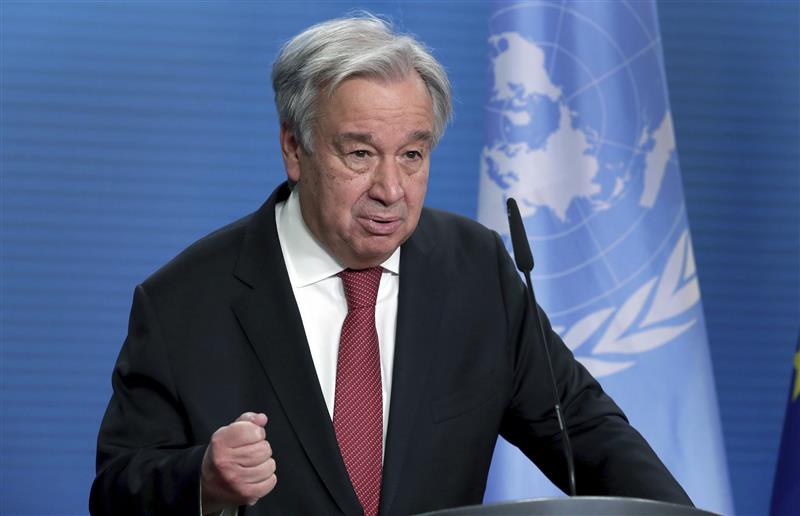
* The photo of António Guterres belongs to ‘Faces of the World’ and has been retrieved from Flickr: António Guterres | Portuguese politician serving since 2017… | Flickr . No changes to the photo were made. Information about the Licence: https://creativecommons.org/licenses/by/2.0/
Tags: United Nations, Security, UN