Learning from Chornobyl? Handling nuclear risks during peace and war
In this EUIdeas piece, Science Diplomacy Fellow Angela Liberatore reflects on the legacy of the Chernobyl/Chornobyl nuclear disaster and how it has influenced policy, crisis response, and wartime concerns over the 40 years since the accident.
Author:

Reading time: 9 min.
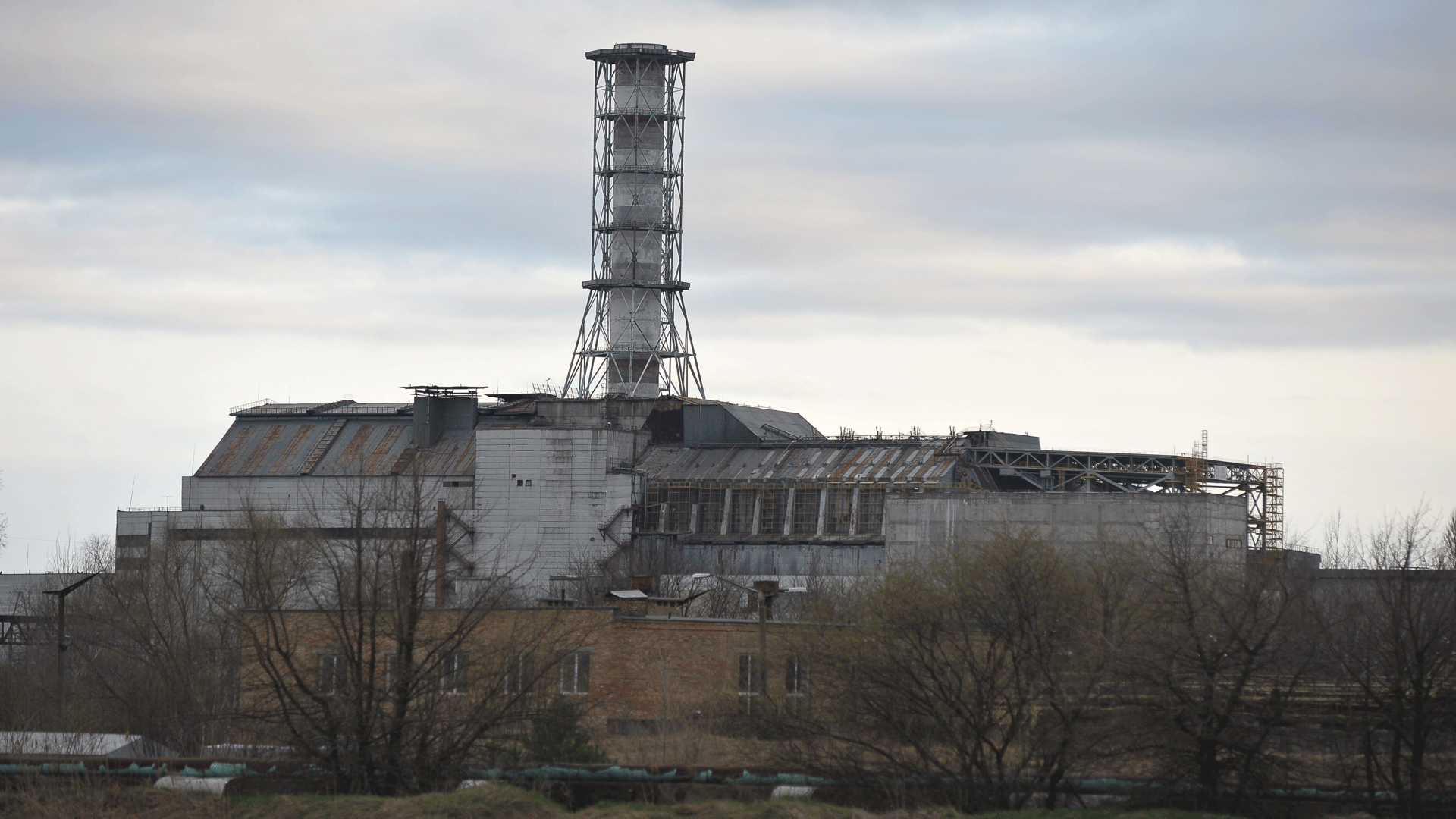
The major accident of 26 April 1986 at Reactor Four of the Chernobyl/Chornobyl Nuclear Power Plant in Ukraine was a human-made catastrophe with casualties, displacements, and other very severe and lasting impacts on the health, environment, and economy of the region. Indeed, its consequences also reached far beyond Ukraine, with the radioactive fallout reaching most European countries and even further.
Forty years after the disaster, tackling its impacts remains a challenge for Ukraine, for Europe more broadly, and at the international level.
What lessons were learned in the aftermath of the accident of 1986, how, and by whom? Did learning continue in the following four decades, including during and after the 2011 Fukushima accident in Japan and during the Russian war of aggression in Ukraine?
When it comes to the name of the accident site, there has been an important shift in generally accepted terminology. As of 2022, the Russian-based spelling of Chernobyl, once the standard name used in reporting on the event, has been replaced by the Ukrainian spelling of Chornobyl as the preferred term of reference. References in this piece to catastrophe and literature dating prior to, and following, 2022 will reflect this shift.
The article briefly addresses three elements. First, it examines the diversity of responses to the Chernobyl accident in three European countries, as well as the reactions of the European Community (the predecessor to the European Union) and the broader international community. Second, it explores the 11 March 2011 accident at the Fukushima Daiichi Nuclear Power Plant, in order to identify whether and how lessons from Chernobyl helped in the management of this more recent disaster. Third, it discusses the military targeting of the Chornobyl and Zaporizhzhia nuclear plants following the Russian invasion of Ukraine. Ultimately, it raises a critical question: Are we witnessing a dangerous regression in our understanding and capabilities around nuclear risks, or do we still possess the capacity to address them responsibly?
Chernobyl 1986: one nuclear disaster, many responses
Once the news on Chernobyl started spreading in Western Europe in late April 1986, a cacophony emerged concerning basic facts (e.g. whether fallout had reached certain countries and to what extent), risks and uncertainties (e.g. whether or not there was any level of radiation exposure that would not be harmful to human health), possible responses, and questions about responsibility for crisis management. Proposed responses ranged from radiation monitoring to halting the sale and trade of foodstuffs at the local, national, and European levels. To understand why such cacophony took place, I compared responses to the radioactive fallout in three neighbouring countries -France, Germany, and Italy- all member states of the European Community, as well as reactions at the European and international levels. These findings are described in my book, “The Management of Uncertainty. Learning from Chernobyl”.
In a nutshell, the different responses ranged from limited release of information and absence of precautionary measures (France) to multiple information sources and health protection measures, such as prohibiting the consumption of Iodine 131-contaminated fresh milk for children and pregnant women and blocking the sale of vegetables contaminated with Caesium 137 (Germany and Italy).
This divergence was due to a mix of factors, including differing degrees of political centralisation. While centralisation was very high in France, it was more diversified in Germany (with mixed competences at federal and state levels) and Italy (where several different ministries and regional health authorities were involved). Other key factors included: 1) the strength of each country’s ‘nucleocracy’ (that is, technocracy specifically related to nuclear power), which was strongest in France due to its important nuclear industry and involvement in both civilian and military nuclear programmes; 2) the type and visibility of expertise that was brought to bear on the policy and public debate in each country (while such expertise was very centralised in France, particularly by the Central Radiation Protection Service and the nuclear industry operator EDF, it was more diffuse and involved the input of experts from government as well as academia on radiation protection, civil protection, monitoring, and risk assessment in the other two countries); 3) civil society mobilisation, which was particularly relevant in Germany due to the country’s strong green movement; and 4) the role of the media, which supported the governmental strategy of very limited information in France for around two weeks after the disaster, but was more involved in debating risks and uncertainties in the other two countries.
At the European level, the policy response to the crisis consisted of activating the European Community System for rapid alerts in case of food contamination, setting maximum levels of radioactivity in foodstuffs, and adopting trade restrictions. Meanwhile, at the international level, the International Atomic Energy Agency (IAEA) facilitated the adoption of two international conventions in record time: the Convention on Early Notification of a Nuclear Accident and the Convention on Assistance in the Case of a Nuclear Accident or Radiological Emergency.
Fukushima 2011: implementing old lessons and drawing new ones
The year 2026 also marks the 15th anniversary of the major accident at the Fukushima Daiichi nuclear plant on 11 March 2011. Unlike the delayed information release at the time of the Chernobyl accident, Japan’s prime minister declared a nuclear emergency and issued public evacuation orders on the same day of the Fukushima accident. That same day, the IAEA’s Incident and Emergency Centre received information from the International Seismic Safety Centre concerning a 9.0 magnitude earthquake in Japan and the detection of an accident at the Fukushima nuclear plant. In September of the same year, IEAE member states officially endorsed the IAEA Action Plan on Nuclear Safety to strengthen safety across 12 critical areas, including safety assessment of nuclear plants, emergency preparedness and response, and national regulatory bodies.
While the Chernobyl fallout reached many countries, Fukushima’s terrestrial fallout was limited to Japan. Its oceanic impact, however, was widespread, with contaminated water reaching other coasts of the Pacific. The release of treated wastewater from Fukushima into the Pacific Ocean started in August 2023, raising concerns by the fishing sector and environmental organisations within Japan, but also by governments of neighbouring countries, namely China and South Korea.
Some key lessons from Chernobyl appear to have guided the response to Fukushima.
First, the legacy of the Chernobyl accident led to rapid information diffusion and declarations of emergency, evacuation, and exclusion areas (where only specialised personnel could enter once the population had been evacuated) within Japan.
Second, it enabled rapid international mobilisation. The IAEA prompted its own alert system, built directly on the two post-Chernobyl Conventions, while other countries stepped in quickly. For example, US Forces provided disaster relief in Japan from 12 March to 4 May 2011.
Third, other nations launched proactive countermeasures. For example, on 11 March 2011, the German Environment Ministry (itself set up in response to Chernobyl) established a dedicated crisis unit after the Fukushima disaster.
Finally, in the European Union, “stress tests” and peer reviews by experts of different countries were performed in the 15 EU countries with nuclear power plants, as well as Switzerland and Ukraine, to assess initiating events, loss of safety systems, and the management of severe accidents
Chornobyl and Zaporizhzhia from 2022 onwards: weaponising civilian nuclear plants
On 24 February 2022, the first day of the Russian war of aggression on Ukraine, Russian armed forces captured the Chornobyl nuclear plant and its exclusion zone. Around 300 people — including workers and security guards for the plant — were trapped inside, coerced into extremely long shifts, and made unable to leave the plant. By 31 March of the same year, most of the occupying Russian troops had withdrawn, leaving the site and its personnel in dire conditions.
In February 2025, a Russian drone damaged the New Safe Confinement (NSC) at Chornobyl, the giant structure built to contain the remains of Reactor Four and enable the safe dismantling of the original ‘sarcophagus,’ which was built hastily to cover the damaged reactor and contain radioactivity after the 1986 accident. Initial assessments by the European Bank for Reconstruction and Development (EBRD) indicate that repairs to the NSC could cost at least €500 million, with work needed to restore the structure to full functionality by 2030. Failure to restore the NSC to its original standard of confinement would seriously jeopardise its planned 100-year lifespan, creating major environmental and safety risks.
In the meantime, the Zaporizhzhia Nuclear Power Plant (ZNPP), another large Ukrainian nuclear plant, has been occupied by Russian military forces since 24 February 2022 and remains under their control. As the Director General of the IAEA, Rafael Mariano Grossi, has emphasised, the situation at both Chornobyl and the ZNPP remains highly fragile. All “Seven Indispensable Pillars” of nuclear safety — including physical integrity of facilities, ability of operational staff to work without undue pressure, and access to off-site power — have been either fully or partially compromised
This situation indicates that the Russian military has dismissed important historical lessons from the catastrophic impacts of the Chornobyl accident on health, environment, economy, society, ultimately ignoring the need to handle nuclear power responsibly. Instead, the memory and devastating potential of a nuclear disaster are being used as tools of terror in Ukraine and elsewhere, with these threats possibly being weaponised to obtain territorial and nuclear energy control, particularly over Zaporizhzhia.
The international safeguards system overseeing civilian nuclear plants is relatively resilient, encompassing monitoring, IAEA inspections (which are very difficult to carry out during wartime), and assistance (such as the EBRD’s work on the New Safe Confinement). However, the broader issue of nuclear weapons proliferation — including the risks induced by the weaponisation of civilian nuclear power — needs far greater global attention.
The third consecutive failure of a five-year review conference of the Treaty on the Non- proliferation of Nuclear Weapons in May 2026 and the attacks on Iranian nuclear plants are concerning signals of reduced capacity and willingness to responsibly manage nuclear power, underlining the fact that significant further effort is needed.
Acknowledgements: Thanks to EUI part-time Professor Oksana Antonenko and Jean Monnet Fellow Olena Snygir, with whom we organised a seminar on the 40-year anniversary of Chornobyl at the EUI, entitled Learning from Chornobyl? Past, present and future.
Tags: Chernobyl, Chornobyl, nuclear disasters, nuclear risks, nuclear power plants