How capital shapes, breaks, and remakes cities
In this first-person account, EUI History Professor Alexia Yates explores how capital shapes cities and crises—an essay on The Power of Knowledge.
Author:

Reading time: 5 min.
On the occasion of the EUI flagship event EUIdeas, which shares this platform’s name, we asked EUI academics: What is the most powerful piece of knowledge you have encountered, and how has it transformed your research?
Here, the personal story of Alexia Yates:
First, the disclaimers. I don’t really think in terms of ‘pieces of knowledge’. Historians approach knowledge as deeply situated (as is our own capacity to engage it). Picking a fact or piece out of its system of meaning – like grabbing a random paper out of its archive box, or a page from a book – renders it wildly difficult to interpret. And no doubt most of us would say the most important knowledge we’ve encountered is not necessarily in the same category as that which shapes our research – it’s probably more on the order of life lessons, like how to be a good friend. That said, it has been quite fun to try to pinpoint particular insights or encounters, bite-sized tastes of theory and evidence, that I haven’t been able to escape from – sometimes despite my best efforts...
Here’s where I’ve settled for now. This is Marx’s theory of capital’s reproduction, schematised by historical geographer David Harvey:
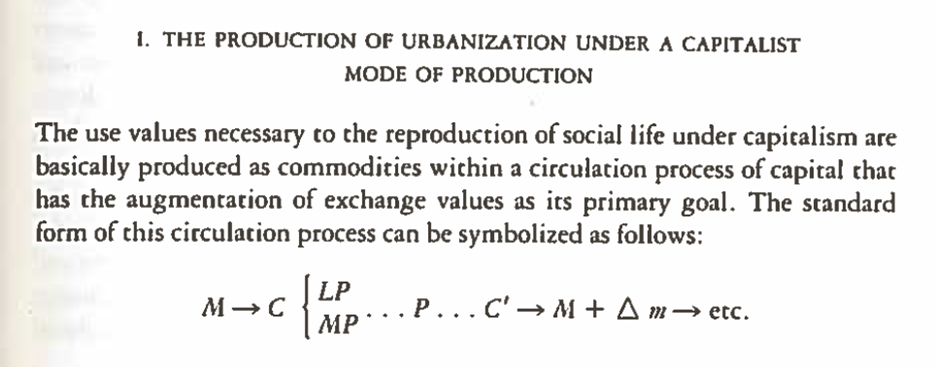
I’m a historian of capitalism and cities, and in my work on the built environment, especially on real estate development, Harvey’s theories have fundamentally shaped how I understand the modern city. What he sketches here is the transformation of money (M) into commodities (C), which involves both labour power (LP) and means of production (MP). Through production (P) new commodities (C') are produced, which are sold for money and generate profit (Δm), producing the means to recommence the cycle of production.
There are two critical things in this theory. First, capital is shown to be a process, with laws of motion that dictate its inherently expansionary and dynamic (ultimately unstable) nature. Overproduction and crises of devaluation are inevitable. Second, and this is Harvey’s signature addition to Marx, is that each of these points in capital’s cycle involves different speeds (timeframes) and distances (space). Harvey puts capital’s reproduction at the core of urbanisation, using these cycles of production, overproduction, and crisis to understand why the material environments we find ourselves in today look and operate the way they do. Capital moves into the built environment in an effort to slow down, an attempt to stabilise and stave off crisis – he calls this the ‘spatial fix’. It succeeds for a time, but ultimately fails, and buildings, neighbourhoods, districts crash, economically and socially.
Of course, the built artefacts of this effort often remain, and force us to reckon with them as new cycles start. So, the environment is built, destroyed, and built again, in capital’s self-image. Unless – and here’s the key bit – we interrupt it.
I started my PhD research as a historian obsessed with Paris. I had never visited, but thanks to a dynamic undergraduate lecturer, I knew that I wanted to know more about the place that claimed to be at the centre of the modern urban experience. I also started my PhD in the run-up to the 2008 financial crisis. This was when real estate became what one scholar called the fundamental ‘widget’ of the global economy – the packaged asset tumbling off assembly lines and into the portfolios of a ‘global pool of money’. Harvey’s model for understanding the intersection of the built environment and capitalism gave me a way of seeing the core elements of our urban landscapes as historically specific artefacts. I first studied how historical actors constructed the very idea of a real estate market in the French capital – the idea that houses sell like any other commodities is very new, and takes a lot of work to sustain – and later studied how investments in land and buildings in European empires further generalised the idea of real estate as a commercial entity. That global, imperial history is embedded in the way we think about and treat real estate today.
There’s so much that remains revelatory and radical about this. Looking around and grasping that the buildings and property lines that shape our everyday lives are doing something… how they are connected to global processes, how they are in movement even as they appear fixed…This thinking might start as a rather arcane dogma about the inescapable laws of capital, but it surgically dissects the many places open for intervention and transformation. Knowing that this is how buildings function under capitalism is fundamental to tackling the affordability crises that are devastating life chances, polarising politics, and alienating citizens in advanced economies around the world. It not only motivates my research and teaching on property, but also keeps me participating in local protests against real estate speculation here in Florence.
Alexia Yates is professor at the EUI Department of History and Chair in European History, 19th and early 20th centuries. She a historian of economic life, focusing on urban history and the history of capitalism in modern Europe, particularly France. In her research and teaching, she pursues the challenge of how we might enliven critical political economy approaches to capitalism with a humanist agenda that accounts for the agency of the people, places, and things that embed and produce capitalism in particular historical conjunctures
Notable recent publications include:
- Real Estate and Global Urban History, Cambridge University Press, 2021
- Built Orders of Finance, Risk, and Racial Capitalism, with Caley Horan, Peter Hudson, Maren Koehler, Jasper Ludewig, and Amy Thomas, Architectural Theory Review, 2022
This EUIdeas essay is a contribution to the conversations of the EUIdeas research festival themed The Power of Knowledge, an occasion to celebrate the EUI’s 50th anniversary. The event aims to reimagine Europe by showing how universities can deploy knowledge to illuminate challenges, inform public debate, and contribute intellectually to the future of our societies.