From Irish tragedy to European constitutional pluralism
Síofra O’Leary reflects on three cases before the Irish and two European courts in the early 1990s which fed slow but sure societal and constitutional change and which spoke early to the emerging multi-level system for the protection of fundamental rights which operates in Europe today.
Author:
Reading time: 6 min.
On the occasion of the EUI flagship event EUIdeas, which shares this platform’s name, we asked EUI academics: What is the most powerful piece of knowledge you have encountered, and how has it transformed your research?
Here, the personal story of EUI alumna Síofra O’Leary:
I have been asked to reflect on a moment, event or series of events which sparked a realisation of “the power of knowledge” and influenced my intellectual path and research.
As I have spent most of my professional life working in the two European courts – behind the bench and then on the bench – I have to adapt the brief slightly to fit that fact.
Research is and always has been a part of my professional life. However, it is and has been research principally carried out for judicial purposes and generally in non-academic settings. Contrary to their critics, most judges do think deeply about the law, its potentially transformative effects, as well as the limits to their judicial function.
A turning point for me came while I was still at the EUI. My research on European Union citizenship, which was not yet a formal legal status but rather an evolving legal phenomenon, focused on the impact of EU law on individuals beyond purely economic integration. In that context, I was drawn to three cases pending in the early 1990s, all of which had a European dimension. The cases concerned the then Irish constitutional position on the right to life of the unborn and the consequent impact on the rights of the born; women and girls, whether pregnant and in distress, or wishing to have access to information about their reproductive rights elsewhere in Europe.
Deeply distressing is an inadequate description of the plight of the 14-year-old girl at the centre of the X case, decided by the Irish Supreme Court in 1992. She had been sexually abused and then raped by the father of a friend. On discovering she was pregnant, her parents arranged for her to travel to the UK. The alleged crime at the origin of this horrific journey was reported to the police by her parents, who were keen to ensure that a DNA sample of the foetus would be preserved for the purposes of any prosecution. In light of the constitutional prohibition on abortion, inserted in 1983 in response to constitutional developments in the US, the Irish authorities applied for an ex parte injunction restraining travel, which was granted at first instance. On appeal, on the basis of a harmonious interpretation of the Constitution, carried out, in the words of the Chief Justice, “in accordance with the concepts of prudence, justice and charity,” the Supreme Court recognised that there may be circumstances in which the termination of pregnancy may be lawful by reason of a real and substantial risk to the mother’s life. The injunction was lifted.
The case shook the country to its core. Leaving aside the harrowing details of the young girl’s experience, the judgment left open the possibility that travel by a pregnant woman outside the jurisdiction could be restrained in certain circumstances. In addition, the medical profession - which explores the balance of risk - and future judges - who explore the balance of rights (to borrow the words of one commentator on the case) - would almost certainly be left to shoulder a heavy responsibility in the absence of regulatory guidance regarding how to proceed. And so it came to pass, with more tragic cases resulting in subsequent years from the fraught medical and legal vacuum which had been created.
Meanwhile, two cases which had originated before X, and which concerned restrictions on the availability of information on abortion lawfully provided in other EU Member States, came before European judges. The Strasbourg court found a violation of the right to freedom of expression due to the disproportionate nature of the perpetual ban, while the Luxembourg court recognised that abortion is a service but declined jurisdiction as a result of the then more limited scope of EU law.
What this trilogy illustrated for me was the transcendental social and political importance of legal rulings; the need for judicial prudence to be counterbalanced by judicial courage and prudent innovation when and to the extent appropriate; the importance of precise and clear legal language, whether in proposed constitutional amendments or judicial opinions; the primary responsibility of democratic decision-makers when it comes to vindication of respect for human rights; the reason why access to justice is essential in a democratic society underpinned by the rule of law, particularly when that responsibility is not shouldered by the State; the law’s failure (regrettably still in evidence today) to protect women and children, and finally the debt which society owes to litigants, like X and her parents, whose names live on (in their case anonymously) as shorthand for the legal rules and principles which their cases establish.
The three cases also illustrated the value, in the face of individual and systemic dysfunction, of exceptional review by courts not part of the national system. Those courts can bring much needed oxygen to ongoing national debates and shine a light on dark realities which a national system may have failed to confront fully.
Thirty-four years later, Europe’s multi-level system requires the two European courts and national courts to collaborate in their judicial work to an ever-greater extent, in a world where the values to which the Irish Supreme Court turned in the X case are increasingly under pressure or ignored. It is vital that complementarity rather than competition continue to inform that complex relationship.
Courts cannot, do not and should not be asked to solve all of society’s problems. The Irish question at the heart of the cases I have just described was resolved in the end at the ballot box by the Irish people. But courts can participate in the rearguard defence of democracy, societal tolerance and the rule of law when any or all of these things are in retreat or under pressure. Even when first ignored or in the minority, judicial opinions can, in the words of a former US Chief Justice, speak to “the intelligence of a future day”.
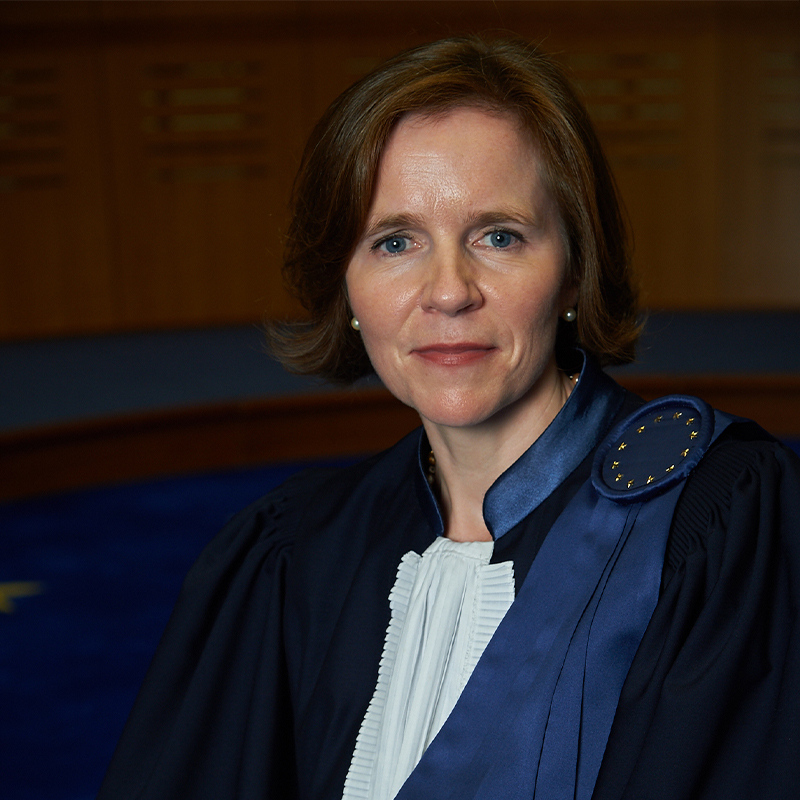
Síofra O’Leary is an alumna of the EUI Department of Law (1989-1992). Notably, she is the former President of the European Court of Human Rights, and is currently Fellow of the Hauser Global Law School and the Remarque Institute, NYU.
This EUIdeas essay is a contribution to the conversations of the EUIdeas research festival themed The Power of Knowledge, an occasion to celebrate the EUI’s 50th anniversary. The event aims to reimagine Europe by showing how universities can deploy knowledge to illuminate challenges, inform public debate, and contribute intellectually to the future of our societies.