From dependency to dignity: Why transnational health is the new engine of Africa’s sovereignty
In this EUIdeas piece, Visiting Fellow Francis Ohanyido examines the African Union’s new health sovereignty agenda, identifies obstacles to strengthening and empowering African health systems, and proposes new strategies for EU-Africa collaboration.
Author:

Reading time: 9 min.
“People often call me an optimist, because I show them the enormous progress they didn't know about. That makes me angry. I'm not an optimist. That makes me sound naive. I'm a very serious 'possibilist’” - Hans Rosling, author of “Factfulness”
The story of African health is still largely narrated through the lens of ‘charity.’ In the popular imagination, the continent is chronicled as a place of perpetual crisis, a region where health is ‘delivered’ from the outside rather than cultivated from within. But a quiet revolution is currently igniting the continent. It is a strategic shift away from donor-centric global health to locally led transnational health.
In November 2025, the Africa Centres for Disease Control and Prevention (Africa CDC) launched the Africa Health Security and Sovereignty (AHSS) Agenda. Building on the New Public Health Order (NPHO), the AHSS Agenda seeks to shift Africa’s role in the global health from a passive importer of solutions to an active co-designer of systems.
The urgency of this switch is underscored by a stark reality: According to the Africa CDC, external health financing to Africa has declined by 70% since 2021, even as outbreak incidences increased by 40% between 2022 and 2024. Most notably in the Official Development Assistance (ODA) space, the dismantling of the United States Agency for International Development (USAID) has created a major crisis in global health. Other notable shrinkages are those of bilateral assistance from the United Kingdom (Foreign, Commonwealth & Development Office / FCDO) and the Netherlands. From the Africa CDC’s point of view, African dignity can only be secured through African ownership of health security.
The ‘triple dependency burden’
To understand the significance of the AHSS Agenda, one must first appreciate the complexity of the structural ‘trap’ it seeks to dismantle. African health systems have been structurally undermined by what is known as the ‘triple dependency burden.’
First articulated in the Accra Reset, a policy document published in 2010 and updated in 2020 as a framework for reclaiming health rights under the African Charter on Human and Peoples' Rights, the triple dependency burden identifies three interrelated forms of dependency that have beset the continent.
The first form is financial dependency, which is characterised by a reliance on external donor funding that dictates local priorities and leaves little room for domestic innovation.
The second form is professional dependency, which is rooted in the continent’s historical dependence on foreign technical expertise and specialist medical personnel to manage systems and produce knowledge.
Finally, commodity dependency refers to an acute reliance on external sources for vaccines, medicines, and technologies — a vulnerability that places the continent at the back of the line during global emergencies like the COVID-19 pandemic.
The AHSS Agenda argues that such dependency is not merely an issue of health but also of sovereignty. When a state cannot secure its people’s basic right to health, it cannot fully assert its economic and political independence.
From global to transnational: why it matters
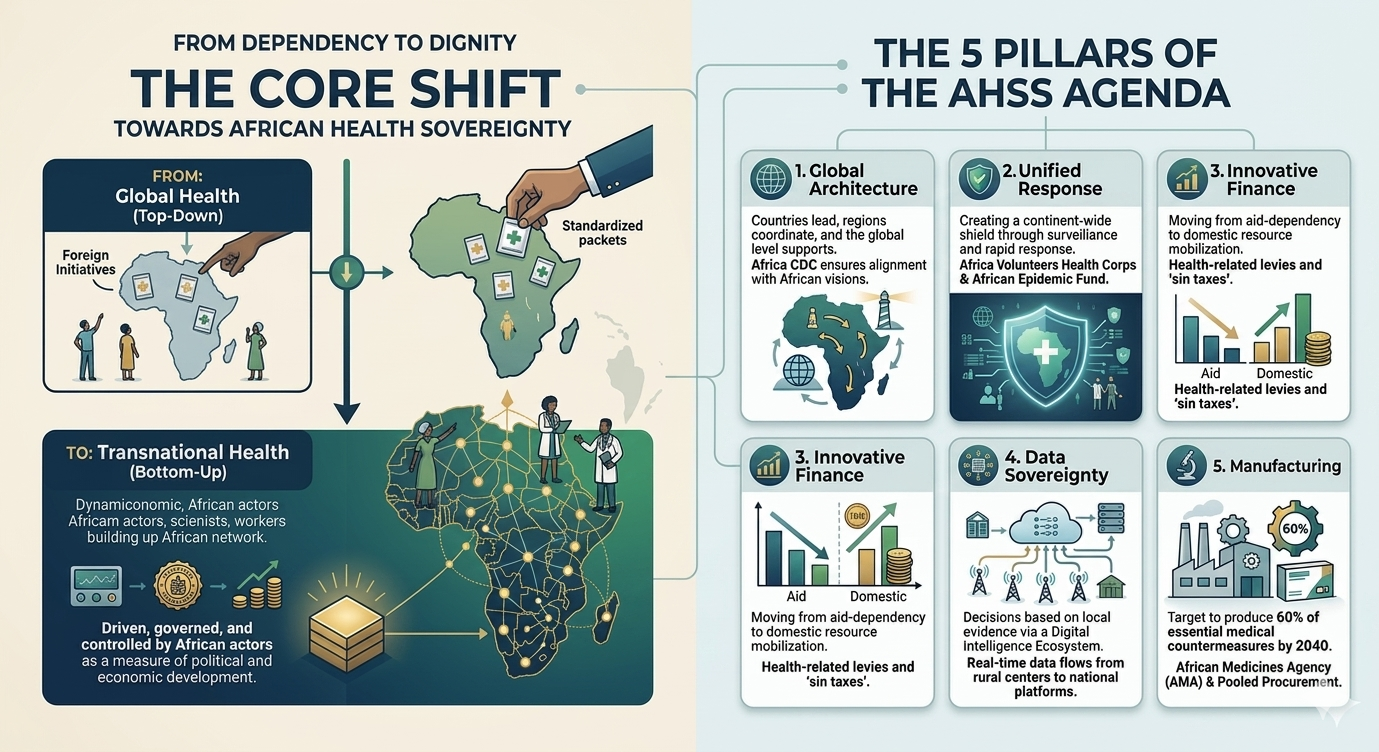
The key difference between the old ‘global health’ model and the emerging ‘transnational health’ model lies in the fact that, while global health has historically been top-down and foreign-led, transnational health is bottom-up and continent-led, and pivots away from both financial and epistemic dependency.
The elevation of the Africa CDC to the African Union’s autonomous health agency in February 2022 marked a turning point in Africa’s health agenda. This has made it the leading transnational health governance institution on the continent, providing a platform to address issues that individual states cannot handle alone. It uses a collaborative, multi-actor process to manage health issues across borders, re-regulate services, and strengthen systems on the continent.
Transnational health is a ‘bottom-up’ action. It treats health as a pillar of political and economic development, driven and governed by African actors based on the continent. By viewing health as human capital, the single largest contributor to Africa’s GDP, this movement has placed the continent on the road to reclaiming its agency in global health security governance.
The five pillars of sovereignty
While the NPHO was created by the Africa CDC in 2021 to fortify security following the COVID-19 pandemic, the AHSS Agenda translates that ambition into five operational pillars. These pillars, which are described below, are the ‘engine’ that aims to move Africa from a state of structural vulnerability towards true resilience.
Reforming the global health architecture
The AHSS Agenda is centred on country-level leadership, regional coordination, and global-level support. Africa is no longer asking for a seat at the table; it is building its own table. The Africa CDC seeks to ensure that global initiatives are tailored to African aspirations, not vice versa.
Pandemic response at scale
By integrating surveillance systems and laboratory networks with a rapid-response workforce (namely, the Africa Volunteers Health Corps (AVoHC)), the AHSS Agenda is creating a health security umbrella for all 55 countries on the African continent. This is complemented by the African Epidemic Fund (AfEF), which ensures immediate availability of resources when a crisis strikes.
Sustainable and innovative financing
The decline of traditional foreign aid from The United States, Germany, France, the United Kingdom, Japan, and the Netherlands has opened up a new era of ‘African health financing.’ This model pushes for reliance on domestic resource mobilisation through health levies and ‘sin taxes,’ (a special tax on harmful goods, like alcohol, tobacco, and sugary drinks, designed to discourage consumption and raise government revenue), as well as blended financing strategies to align external resources with long-term national health plans.
Data sovereignty and digital transformation
Data has been called ‘the new oil’, a concept originating from the title of a 2006 speech delivered by British mathematician Clive Humby.
The AHSS Agenda seeks to build a digital intelligence ecosystem that facilitates a real-time flow of information from rural health centres to national authorities. By securing data sovereignty, African actors can ensure that health decisions are based on their own evidence and local realities.
Manufacturing revolution
Supported by the African Medicines Agency (AMA) and the African pooled procurement mechanism, Africa plans to produce 60% of essential medical countermeasures, including vaccines, diagnostics, and therapeutics, on African soil by 2040.
A cautionary note on the success tempest
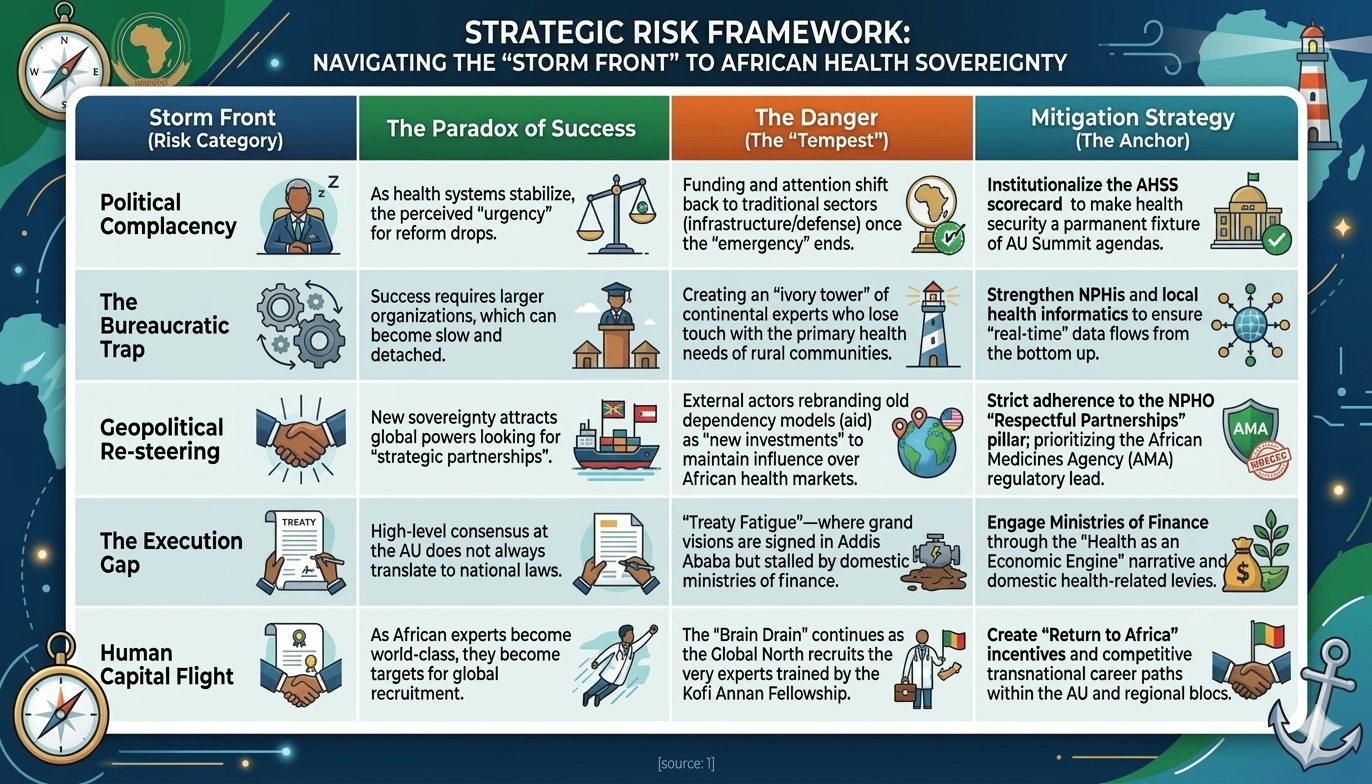
As a possibilist, I must inject a note of caution. While the AHSS Agenda has ignited a great ‘fire’ of enthusiasm among African leaders, the heat from this fire needs to be tempered. The rise of the Africa CDC and the emergence of the NPHO have been accompanied by what I call a ‘success tempest.’ As the continent expands its power and autonomy, it may also become increasingly vulnerable. The greatest danger is a return to ‘business as usual’ once the immediate danger of a pandemic passes. The ‘tempest’ of global geopolitics may lead foreign actors to seek to destabilise this new sovereignty, disguising dependency as ‘new partnerships.’
Sovereignty is not a prize; it is an ongoing political process. If the AHSS Agenda becomes a mere technocratic exercise rather than a people-driven movement for health dignity, we risk replicating elite dependencies instead of creating continental autonomy to transform African health systems.
The challenge to leadership: beyond consensus
African leaders’ political will to achieve health sovereignty is visible. This is evident from Rwandan President Paul Kagame’s meeting with African heads of state in Addis Ababa to Ghanaian President John Mahama’s high-level meeting in Accra. But vision means little without implementation. African leaders must move beyond consensus to collective action, which requires a new era of bold common accountability. This must be anchored by continental accountability mechanisms, such as a unified continental scorecard to track progress in strengthening health systems across all African Union member states. This will require ethical scrutiny to ensure that transnational partnerships reinforce local systems instead of superseding them.
The ankh (key) to the shift from dependency to self-determination lies in human capital. Africa must prioritise initiatives such as the Africa CDC’s Kofi Annan Fellowship in Global Health Leadership and Public Health Informatics Fellowship programme, the Academy of Public Health (APH)’s Young Professionals in Public Health programme (YPPH), and collaborations with non-state public health institutes (NSPHIs) to ensure that the next generation of experts is homegrown.
The Africa–EU Partnership: a new model?
The Africa–EU Health Partnership, underpinned by an EU Global Gateway investment of more than €2 billion in high-impact projects such as vaccine and pharmaceutical production, represents a potential pivot toward a ‘partnership of equals’ model, focused on local production and pandemic preparedness rather than commodity distribution. This is the essence of transnational collaboration: a model that upholds African sovereignty while strengthening global security.
The movement from dependency to dignity is not just an African victory; it is a global imperative. A secure, self-reliant Africa is the most robust guarantee for global health security. When the continent is empowered to detect, respond to, and manufacture countermeasures against its own threats, the entire world can breathe easier.
The European University Institute (EUI)’s Florence School of Transnational Governance (STG) is well placed to serve a catalytic role as a ‘knowledge bridge’ in the transition from global health dependency towards African health sovereignty. By strategically aligning its assets with the Africa Health Security and Sovereignty (AHSS) Agenda, the EUI can help elevate the EU-Africa partnership, moving it away from simple commodity distribution and towards shared intellectual and regulatory co-creation.
In this translational policy framework for sovereignty, the EUI could collaborate with African institutions as a neutral support incubator. Here, the ‘triple dependency burden’ can be dismantled via a peer-to-peer model in which African public health leaders and European policy architects co-design the future of the EU-Africa Health Partnership. Furthermore, by hosting necessary ‘track-two’ dialogues (non-govermental discussions aimed at building trust and exploring new ideas outside the constraints of formal government negotiations), the EUI can help transform the AHSS Agenda from a mere technocratic exercise into a resilient, people-driven political movement.
Both infographic images used to illustrate the article were generated with Gemini, Google’s generative AI assistant.