Beyond the grid: a new future for Ukrainian apartment buildings
In this EUIdeas piece, Jean Monnet Fellow Alina Soloviova explores the growing importance of apartment owners’ associations in helping Ukraine’s energy system face wartime challenges and align with EU regulations.
Author:

Reading time: 6 min.
Prolonged Russian attacks on critical energy infrastructure are increasing the vulnerability of Ukraine’s civilian population ahead of winter and creating additional risks for people already living in extremely difficult conditions, the Independent International Commission of Inquiry on Ukraine stated in its latest oral update to the UN Human Rights Council. Demonstrating this threat, Russian armed forces struck multiple energy facilities across Ukraine, including Kyiv’s three main power stations, on 13 and 14 October 2026, temporarily leaving 600,000 people in Kyiv without electricity.
From centralised power to local resilience
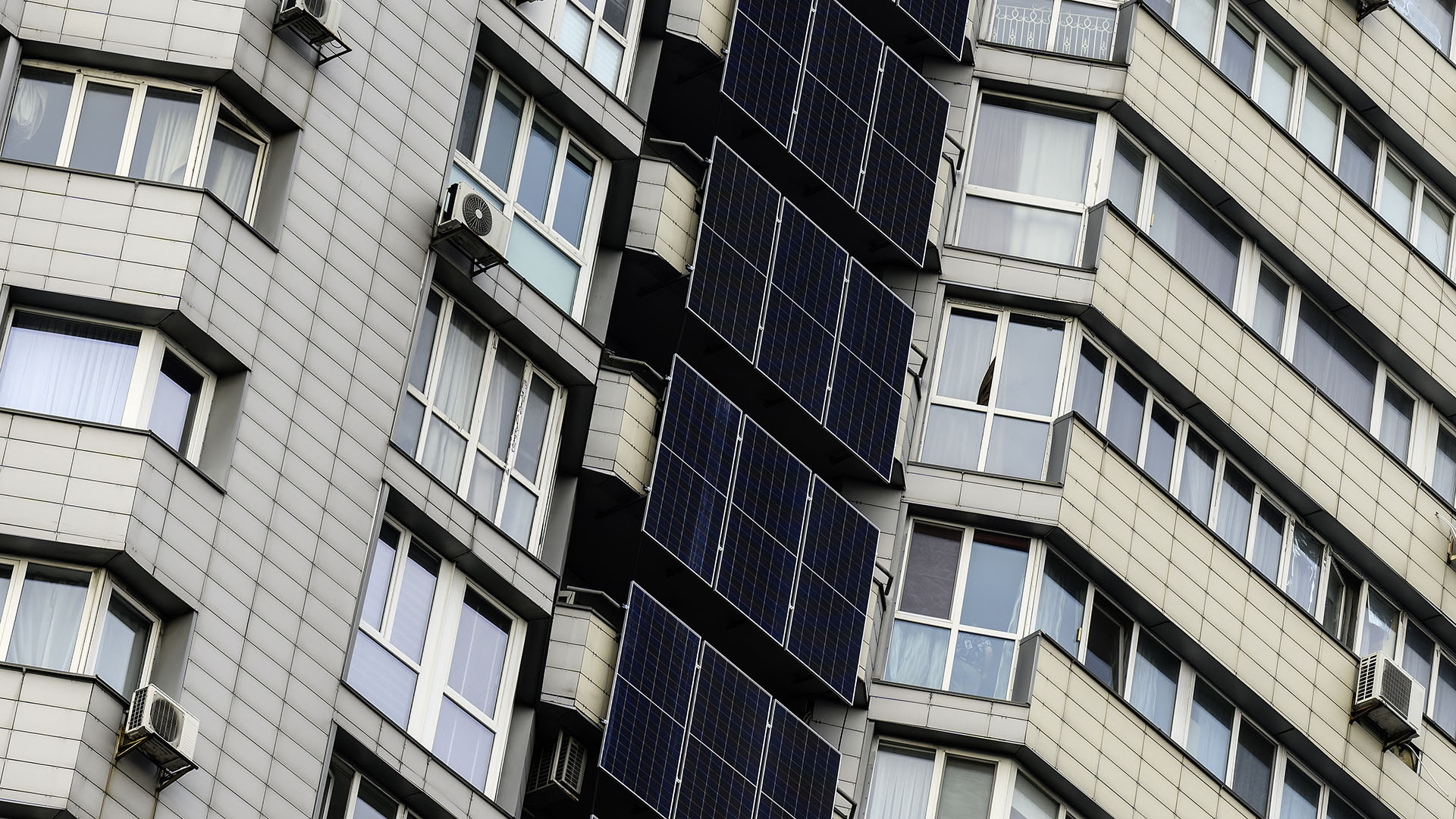
Wartime challenges require decentralising Ukraine’s energy system. Consequently, optimising energy consumption in apartment buildings by installing solar power plants is a key trend for 2026. “Solar energy is one of the tools for addressing the state’s multifaceted challenge of saving the energy sector, making it sustainable and resilient, and ‘rebooting’ it by transitioning from the centralised generation inherited from Soviet times to distributed generation,” said Oleksii Korchmit, head of the Ukrainian Association of Energy Service Companies.
This approach aligns with the policy of bringing Ukraine's national energy laws in line with EU standards (Directives (EU) 2018/2001 and (EU) 2019/944). Currently, Ukraine has adopted approximately 61% of European legislation in the renewable energy sector.
The changing status of apartment owners’ associations
At the level of residential buildings, this shift toward local energy resilience is reflected in the legal framework. Under Article 385 of the Civil Code of Ukraine, owners of apartments and non-residential premises in a multi-apartment building may establish an Association of Co-owners of an Apartment Building (Obiednannia spivvlasnykiv bahatokvartyrnoho budenku, or OSBB) to manage the building and its common property. An OSBB is a legal entity formed by building owners to manage, maintain, and use the common property (Law of Ukraine ‘On Associations of Co-Owners of Apartment Building’).
On 30 November 2022, the Supreme Court considered whether an association of co-owners of a multi-apartment building (OSBB) could be legally classified as a collective household electricity consumer. Applying the law by analogy, the Court concluded that an OSBB represents the collective interests of apartment owners to secure the provision of electricity to meet the shared needs of the building, clearing the path for OSBBs to invest in joint energy systems like solar installations.
Becoming active electricity consumers
An increasing number of co-owner associations are installing solar power plants on apartment buildings. Sometimes, the amount of electricity generated by such a plant exceed the association's current consumption. To ‘sell’ electricity to the grid, the association must obtain ‘active consumer’ status.
A 2023 law entitled ‘On Amendments to Certain Laws of Ukraine Regarding the Recovery and 'Green' Transformation of Ukraine's Energy System’ gave OSBBs the right to acquire active consumer status and to sell surplus electricity (i.e. electricity that is generated but not consumed) to their electricity suppliers under the self-generation mechanism.
The National Commission for State Regulation in the Energy and Utilities Sector has clarified two main ways to use this right 1) when the Association of Co-owners of the Apartment Building (OSBB) connects generating units and/or energy storage units to the apartment building's electrical networks; and 2) when residents connect generating units and/or energy storage units to the electrical networks of apartments and/or non-residential premises.
The development of distributed generation, including the self-generation mechanism, is critical during wartime resilience efforts. It will also play a vital role in post-war development and Ukraine’s path toward EU membership, as highlighted in the National Strategy for the Development of Distributed Generation.
Can Ukrainian OSBBs become energy communities?
On 7 April 2026, the Ukrainian Parliament amended the Law ‘On the Electricity Market’, introducing a legal framework for citizen energy communities.
According to the updated law, an OSBB can serve as the organisational and legal foundation for establishing a community energy association. This association can also take other forms (such as an energy cooperative or a civil society organisation), provided that these forms meet the limits and requirements of energy legislation. Regardless of its legal form, participation in the association must be voluntary and open to members; profit-making must not be its primary objective; and its founding documents must authorise energy-related activities, such as generating, storing, or supplying electricity.
To help OSBBs cope with frequent power outages caused by damage to energy infrastructure, state and municipal programmes offer financial and technical support to OSBBs.
"The state is providing additional tools to enable Ukrainians to manage their own energy consumption. We recognise that installing a power plant or a high-capacity generator for a home is currently expensive for many, so we are making this option as accessible as possible. The state is helping to cover the cost of this equipment to ensure that apartments and houses have water and electricity, and that people are not dependent on power outage schedules," noted Oleksii Sobolev, Minister of Economy, Environmental Protection, and Agriculture of Ukraine.
To put this into action, Ukraine’s Ministry of Development met with associations of apartment building co-owners to launch the ‘SvitloDim’ state support programme. Through this initiative, apartment buildings can receive up to 300,000 hryvnias to purchase autonomous power sources.
Moreover, many Ukrainian cities (such as Lviv, Kyiv, Odesa, and Kharkiv) operate their own local partial reimbursement programmes, such as ‘Smart Neighbourhood’ and ‘Warm Home.’ These programmes allow OSBBs to recover between 30% and 70% of costs from the municipal budget for purchasing generators, inverters, and batteries, as well as for repairing utility systems or installing meters.
Aligning with EU law
While these support systems are up and running, the legislative work to harmonise Ukraine's energy legislation with the EU's is not yet complete. Ukraine is pursuing legislative changes to align its laws as closely as possible with the European Union's requirements.
The Ukrainian Parliament has passed, in the first reading, draft law No. 14271 on renewable energy sources. Adoption of this act is necessary to implement EU renewable energy legislation.
What’s next for Ukraine’s OSBBs?
OSBBs have evolved from mere household consumers into genuine players in the energy sector. The next step is to shift away from a strategy of survival and cost-cutting and towards becoming active participants in the energy landscape. Ukrainian OSBBs can become true energy communities, but they must remove certain barriers, particularly bureaucratic and technical hurdles that make it more difficult to sell surplus electricity from solar power plants to the grid.
Tags: Ukraine, energy, energy resilience