Beyond the EU Global Gateway: Why know-how is Africa’s true path to pharmaceutical manufacturing autonomy
Policy Leader Fellow Teopolina Namandje highlights a critical weakness in EU-Africa health partnerships — namely, the difficulty of transferring tacit expertise — and explores strategies for strengthening pharmaceutical manufacturing in Africa.
Author:

Reading time: 5 min.
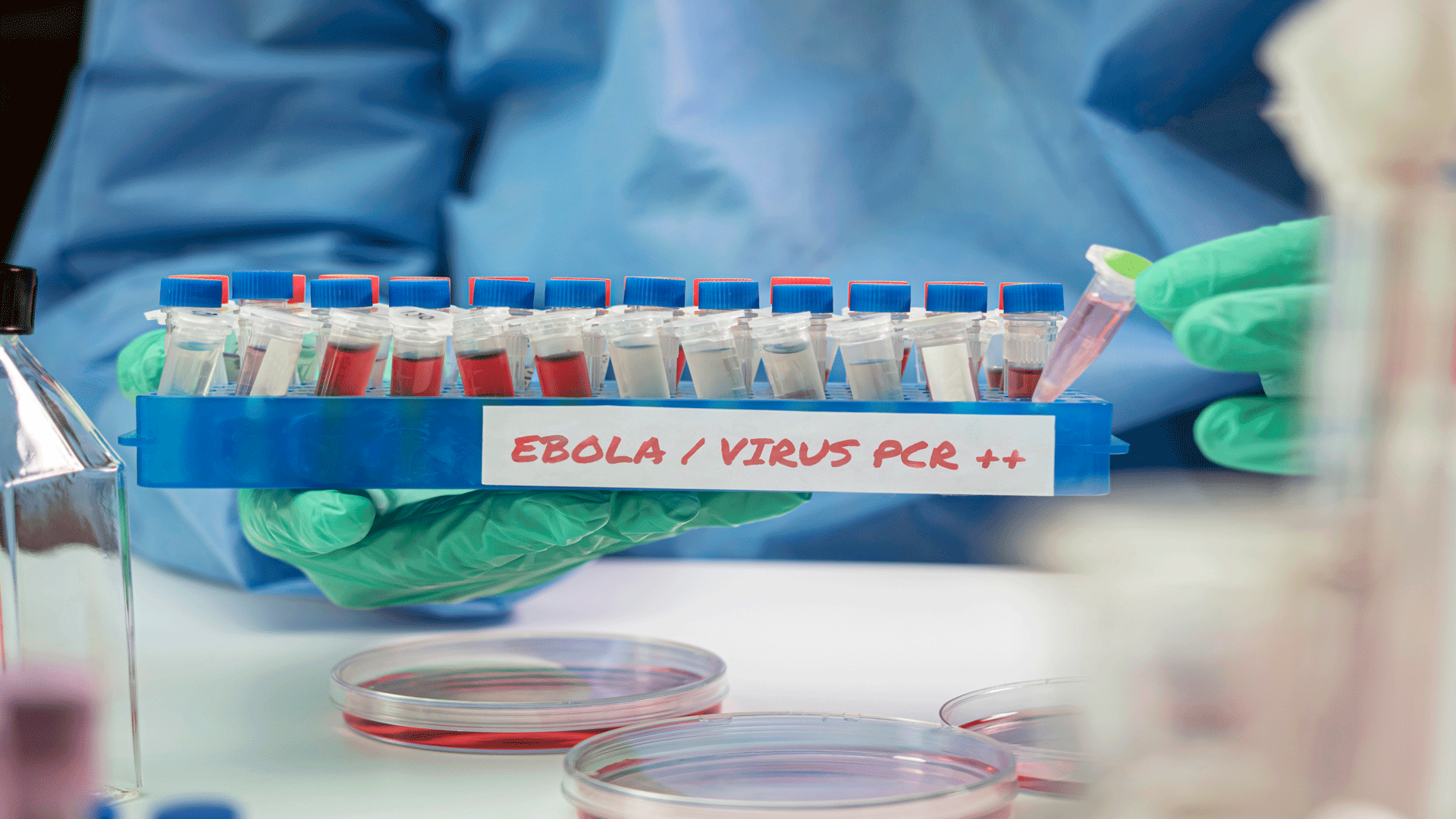
Recent Ebola outbreaks in Uganda and the Democratic Republic of Congo (DRC) have once again highlighted the importance of rapid access to vaccines, diagnostics, and resilient health systems. While these outbreaks are being managed through coordinated national and international responses, they serve as a stark reminder that Africa’s health security cannot depend solely on emergency support mechanisms.
The European Union’s Global Gateway, through the Manufacturing and Access to Vaccines, medicines and health technology products in Africa (MAV+) flagship project, aims to support Africa’s health manufacturing and facilitate access to high-quality, safe, effective, and affordable health products as per UN Sustainable Development Goal (SDG) Target 3.8. The MAV+ is a major €2 billion Team Europe flagship project under the EU's Global Gateway strategy to help African countries strengthen local pharmaceutical manufacturing in order to reach the African Union (AU)'s goal of producing 60% of the continent's vaccines locally by 2040.
The MAV+ initiative supports sustainable local manufacturing in Africa through three dimensions: the supply side, the demand side, and the enabling environment. MAV+ has provided significant investments in South Africa (€697.14 million), Senegal (€226.44 million), Nigeria (€32 million), Rwanda ( €115.29 million), and Ghana (€43.5 million) to position these countries as hubs for pharmaceutical innovation within Africa. Fifteen South African Health Products Regulatory Authority (SAHPRA) staff members have been trained on vaccine and pharmaceutical sector regulations, while 180 others took part in online biomanufacturing training. These initiatives, along with the deployment of technical assistance to the Delivery Unit of the Senegal National Regulatory Authority and Ministry of Health, are good examples of EU investments in Africa. These efforts illustrate a growing momentum toward pharmaceutical production throughout the continent. Recently, the Africa Medicine Agency (AMA) in Kigali, Rwanda, was twinned with the European Medicine Agency (EMA) to provide meaningful operational support.
However, beyond financial investment, a less visible constraint will ultimately determine whether these initiatives translate into a larger systemic shift. Building sustainable manufacturing and scientific capabilities on the continent is increasingly becoming a strategic imperative. The continent’s vulnerability remains evident, as Africa still imports over 90% of its vaccines and about 95% of medicines. Furthermore, the recurrence of Ebola reinforces the urgent need for Africa to strengthen its capacity — not only to respond to public health emergencies, but also to manufacture critical health products closer to where they are needed most.
Know-how: the missing ingredient
As economist Ricardo Hausmann has argued in his work on development and productive capabilities, the binding constraint to development is often not capital itself, but rather the accumulation of tacit knowledge embedded within people, institutions, and industrial systems. This insight is particularly relevant to vaccine manufacturing, where success depends not merely on physical infrastructure but on highly specialised scientific and technical capabilities.
Pharmaceutical manufacturing is one of the most complex industrial processes in the world. It requires expertise in biotechnology, process optimisation, quality assurance, regulatory compliance, cold-chain systems, and large-scale production management. Much of this expertise is tacit — embedded in industrial routines, scientific practice, laboratory culture, and institutional experience, rather than easily transferable through manuals or procurement contracts. This is why many pharmaceutical manufacturing projects across developing economies struggle to reach full-scale innovation and production capacity.
Building know-how: beyond infrastructure
For Africa, the conversation around pharmaceutical local manufacturing must move beyond factories. Sustainable pharmaceutical manufacturing will require long-term investment in scientific education, industrial training, applied research, and institutional learning systems. Universities and research institutes must take a leading role by partnering with industry, regulatory authorities, and global manufacturers to facilitate the transfer of technical capability and industrial experience.
Equally important is the establishment of regional centres of excellence dedicated to biotechnology, pharmaceutical engineering, regulatory sciences, and knowledge sharing. These institutions could serve as continental hubs for specialised training, collaborative research, and knowledge sharing. Industrial partnerships — developed through apprenticeships, technical fellowships, and staff exchanges between African and European institutions — will also be critical in accelerating practical learning and skill development. Notably, several African countries already possess emerging pharmaceutical and scientific capabilities. South Africa, Senegal, Rwanda, Egypt, Morocco, and Tunisia have made progress in pharmaceutical manufacturing, biotechnology partnerships, and regulatory strengthening. The current challenge is scaling these advancements into sustainable regional manufacturing ecosystems.
From dependence to interdependence
With Africa’s pharmaceutical market projected to reach $50 billion by 2030, the opportunities are significant. Manufacturing medical products on the continent can strengthen supply chains, reduce dependency, create jobs, boost healthcare provision, and support broader industrial development.
But getting to this point will require strong institutions coupled with technical capabilities.
The goal should not be isolation from global pharmaceutical systems; rather, it should be a transition from dependence to interdependence, in which African countries participate as competitive partners within global systems. This transition will require more than external support: it calls for domestic capacity that can endure beyond individual partnerships or funding cycles.
What progress should look like
Achieving the 2040 local production target will require stronger domestic leadership from the governments of Africa’s 55 countries. As Africa expands its manufacturing capacity, policymakers must move the focus of negotiations beyond factory infrastructure alone. They must begin to actively lobby for knowledge equity, long-term investment in technical skills, the expansion of centres of excellence, the creation of regional manufacturing hubs, and an increase in African-led research, development, and institutional capacity. Strong regulatory mechanisms must also be enforced to ensure the safety and effectiveness of medicines, support innovation, and create the credibility needed for long-term investment.
If the EU's Global Gateway succeeds in embedding know-how rather than simply financing infrastructure, that will be the true measure of partnership. That moment would represent a turning point not only for vaccine manufacturing, but for Africa’s broader development trajectory towards Agenda 2063.
Tags: Africa, Health, Europe Africa cooperation