Between retreat and return: the persistence of the State amid the increasing power of Big Tech
Thirty years after Susan Strange’s ''The Retreat of the State'', Lucía Bosoer explores the shifting boundaries of political authority in a world where Big Tech wields significant structural power, but the State shows no clear signs of retreat.
Author:

Reading time: 5 min.
Thirty years ago, Susan Strange, the world-renowned international relations scholar, published her seminal book The Retreat of the State: The Diffusion of Power in the World Economy (1996). As she noted in the preface, many of the ideas developed in the book took shape during her time at the EUI, where she served as professor of international political economy between 1988 and 1992.
The book was driven by a fundamental question: Where does authority truly lie? Importantly, she singled out the rapidly evolving technological landscape as a key factor in shifting the balance of power between states and markets. In this respect, the book was remarkably prescient. Yet, even Strange may not have anticipated the far-reaching implications that technological development would have just three decades later, nor the unprecedented power that large technology companies would come to wield.
The growing concentration of corporate power
We live in a world where technological development is increasingly shaped by a handful of companies whose market capitalisation exceeds the GDP of several countries and, in some cases, entire regions. The growing power of big tech companies is reflected not only in the extraordinary valuations of individual firms (Nvidia, Alphabet, Apple, Microsoft, and Amazon were each worth between $2.6 and $4.5 trillion in early 2026), but also in the fact that digital giants now account for seven of the world's ten most valuable companies. These companies have moved from being influential actors within a single sector to occupying a commanding position in the global economy as a whole.
The boom in generative AI has accelerated this concentration. As Cecilia Rikap (2024) shows, Microsoft, Google, and Amazon frequently rank among the top five investors in AI companies that have secured venture capital funding since the launch of ChatGPT. While these firms are pursuing dominance strategies across the entire AI ecosystem, their most consequential source of power increasingly resides in the infrastructure layer. In 2024, Amazon Web Services (AWS), Microsoft Azure, and Google Cloud collectively accounted for 65% of the global cloud computing market. Control over cloud computing services allows them to shape the conditions under which other firms develop and deploy AI systems, reinforcing their dominance throughout the AI stack.
States have become increasingly dependent on these companies for the provision of key digital infrastructures and, in some cases, for the delivery and operation of public services themselves. This gives these firms an unprecedented capacity to influence government decision-making and shape policy design. In her book, Strange observed how, in the early 1990s, firms had increasingly expanded their political functions to the point of maintaining de facto ‘embassies’ in Brussels and Washington. Today, the relationship appears reversed in many respects: it is states that are beginning to establish their own diplomatic presences in Silicon Valley, further underscoring the emergence of major technology companies as significant actors in international affairs. This shift is reflected in Denmark’s appointment of the world’s first tech ambassador in 2017, as well as in the opening of the European External Action Service’s office in 2022.
The persistence of the State
Yet at the same time that this trend intensifies, the State, as the most important unit within the international system, shows no clear signs of retreat. On the contrary, the unparalleled power concentration by Big Tech is one of the main drivers behind the recent surge in digital sovereignty claims worldwide. As a handful of companies increasingly control critical infrastructure for the normal functioning of the state, governments are realising their vulnerability, and they seek to reverse this trend. This is particularly evident if we consider that the US government is among the few not claiming greater digital sovereignty, arguably because it does not face such pressures: most of these companies are American and, for the most part, closely aligned with political power.
More broadly, state power asserts itself within a geopolitical context defined by the growing rivalry between a declining superpower and an ascending one, with conflicts such as the wars in Ukraine and the Middle East highlighting that territorial boundaries and the strategic relevance of geography remain contested yet central dimensions of the international order.
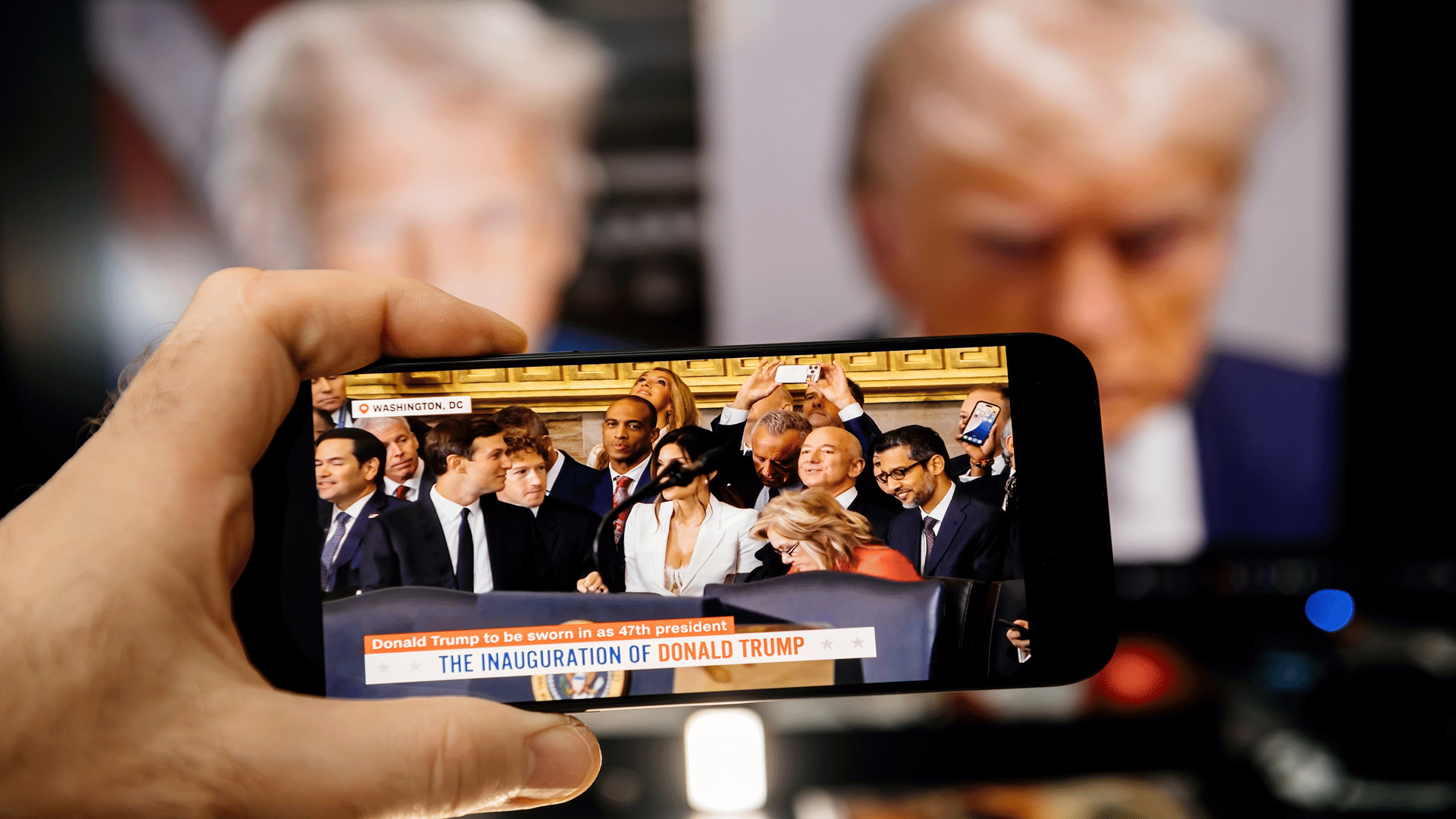
Strange’s work reminds us that concerns about the expansion of corporate power beyond the state are not new. Recent developments, however, suggest that these dynamics may be intensifying. The second presidency of Donald Trump made explicit a longstanding proximity between corporate and state power. But perhaps more importantly, it also highlighted the conditions under which increasingly powerful firms may begin to contest state authority. Indeed, episodes such as the dispute between Anthropic and the US Department of Defense early this year (concerning the conditions under which advanced AI systems could be deployed in defence-related contexts, including concerns around surveillance and autonomous weapons) point to a broader reconfiguration of power relations, in which leading technological companies may not only reinforce their home state’s power globally but also increasingly challenge that same authority.
States, Big Tech, and the contestation of political authority
It is difficult to argue that the state is in retreat today, even though the contemporary state has evolved in ways that depart significantly from any idealised Westphalian conception (which may, in fact, never have fully existed). What emerges instead is the structural power acquired by Big Tech companies, which poses new and significant challenges to established forms of political authority. These companies have ceased to be mere economic actors influencing domestic and international politics and are increasingly becoming “world makers,” as Adler-Nissen and Liebetrau (2026) recently define them: entities that are “actively reshaping the basic categories through which international politics is understood and practiced.” It may be in the evolving spaces of encounter and arenas of contestation between states and Big Tech companies that the resilience of the state as the foundational actor in the international system will be tested. These dynamics, however, will not unfold uniformly; rather, they will be mediated by states’ varying capacities, interests, and political will to resist, contest, or accommodate the growing power of these firms.
Tags: Big Tech, State, power, political authority