Justice denied: How international courts are failing to uphold reproductive justice
The next UN Session of the Commission on the Status of Women focuses on ensuring access to justice for women. Sabrina Frydman & Anna Śledzińska-Simon argue that, while crucial, access to courts and formal legal procedures is not enough to ensure meaningful access to reproductive justice.
Authors:


Reading time: 6 min.
As the United Nations approaches the Seventieth Session of the Commission on the Status of Women (CSW 70) in March 2026, with its focus on ensuring access to justice for all women and girls, we argue that access to justice is fundamental to achieving reproductive justice.
The reproductive justice framework views reproductive rights as human rights and stresses that states must ensure the social, political, and economic conditions that allow people to make empowered choices about sexuality and parenting. Crucially, reproductive justice cannot exist without independent courts and effective legal remedies. Yet, recent rulings by the European Court of Human Rights (ECtHR) against Poland and the Inter-American Court of Human Rights (IACtHR) against El Salvador concerning women’s reproductive rights show that mere access to courts or legal procedures is not enough, particularly where judicial systems are politically influenced or unresponsive to women’s urgent pleas.
El Salvador: Beatriz
In El Salvador, abortion is criminalised in all circumstances, exposing healthcare providers and pregnant women to prosecution — even when a woman’s life is at risk. This reality defined the case of Beatriz, a 21-year-old living in poverty in Jiquilisco. She suffered from multiple chronic illnesses, including systemic lupus erythematosus, lupus nephropathy, and rheumatoid arthritis. At around 13 weeks of pregnancy, an ultrasound revealed that Beatriz’s fetus had anencephaly, a severe malformation of the brain and skull that makes survival outside the womb impossible. Her medical team determined that terminating the pregnancy was necessary to protect her health, yet the country’s absolute abortion ban prevented them from intervening.
Beatriz sought judicial relief, pleading for access to an abortion so she could survive and continue caring for her two sons. After 48 days, the Constitutional Chamber of the Supreme Court rejected her amparo (writ for protection), citing the total criminalisation of abortion and the constitutional protection of life “from the moment of conception.” Ultimately, she underwent a C-section at 26 weeks due to complications. The infant died five hours later.
Poland: A.R.
A.R. was 29 years old and the mother of a healthy preschool-aged child. She and her family had eagerly awaited her second child. She was 15 weeks pregnant when a politically influenced Constitutional Court ruling removed fetal abnormality as a legal ground for abortion. Two weeks later, prenatal testing confirmed her unborn child had trisomy 18, or Edwards syndrome - a severe chromosomal condition causing profound developmental abnormalities. Most fetuses with trisomy 18 die in utero or shortly after birth; infants who survive face extreme suffering, severe disabilities, and very limited life expectancy.
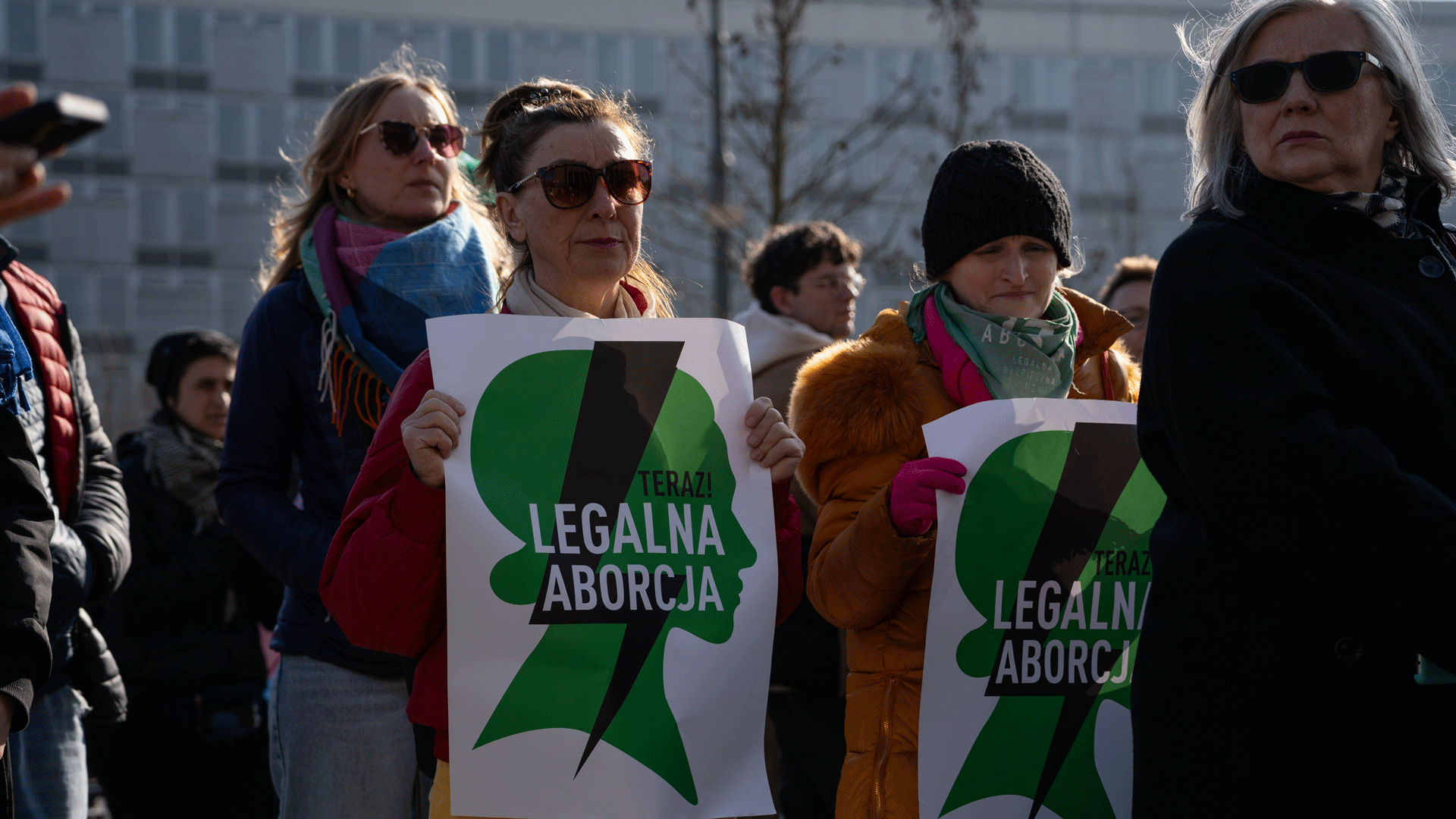
For A.R., continuing the pregnancy posed serious physical and psychological risks, with no chance of survival for her child. The ruling left doctors in legal limbo, especially because its publication was delayed for three months in response to widespread protests against the Constitutional Court’s ruling on abortion (known as the Women’s Strike). With hospitals refusing care under ‘conscience clauses’ and with COVID travel restrictions in place, she nevertheless traveled to the Netherlands for a safe, timely termination. Had the baby been born, it would have suffered a slow and agonising death.
International courts’ reactions
In both cases, international courts found violations of the rights of the pleading women but stopped short of addressing the root cause: the criminalisation of abortion.
There is a growing understanding by international bodies that denying even minimal access to abortion — in cases when a woman’s life or health is at risk, fetal anomaly, or the pregnancy resulted from sexual violence — is a form of inhuman and degrading treatment, and sometimes even torture. By failing to confront this injustice, the courts missed a vital opportunity to improve women’s lives.
In Beatriz’s case, on November 2024, the IACtHR ruled that El Salvador violated the rights to health, judicial protection, private life, and personal integrity of both Beatriz and her family. It also found El Salvador responsible for obstetric violence (a form of gender-based violence defined as mistreatment or abuse during pregnancy, childbirth, or the postpartum period, which is prohibited by the Inter-American Convention of Human Rights and the Belém do Pará Convention). It ordered El Salvador to adopt protocols guiding medical and judicial personnel in cases when a pregnancy puts a woman's life or health at risk.
However, one dissenting Judge, Sierra Porto, argued that the order to adopt protocols would be insufficient on its own if the Court did not demand reform or abolition of the absolute abortion ban — the true source of legal insecurity, discrimination, and inhuman and degrading treatment for many women. The Court did not explicitly recognise that a total abortion ban violates human rights, nor did it apply its established standards on “reproductive autonomy” — including the right to decide whether or not to have children and the right to adequate sexual and reproductive healthcare.
In its recent November 2025 decision on A.R.’s case, the ECtHR found that legal uncertainty caused by the delayed publication of the Constitutional Court’s ruling violated A.R.’s right to respect for private life. This uncertainty surrounding her enforceable rights compelled A.R. to seek care abroad, causing significant additional stress. A.R.’s case is just one of many similar cases that reflect a broader systemic problem, and the Court’s framing of the issue raises a deeper question: Had the Court not been politically influenced and had the judgment on A.R.’s case been published on time, would legal certainty (denoting stability, predictability, and consistent application of law) have been preserved? Would A.R’s private life have remained unaffected? The reasoning of the judgment suggests that states need only ensure legal certainty regarding access to abortion, implicitly releasing the state from further responsibility for the fate of women seeking an abortion. In the struggle for women’s rights, framing A.R.’s case solely as an indictment of Poland’s rule-of-law crisis misses the critical underlying point: that is, reproductive autonomy cannot be fully realised within the narrow constraints of criminal law.
The road once taken: advancing the international right to abortion
While both international courts found that legal uncertainty and medical professionals’ fear of criminal liability led to the violation of Beatriz and A.R.’s rights, only the IACtHR went further by explicitly naming this harm as ‘’obstetric violence.’’ This stands in contrast to the ECtHR’s failure to recognise that denying abortion in tragic cases of fatal fetal abnormalities constitutes inhuman treatment, gender-based violence, and discrimination against women. Both cases underscore the urgent need for clearly defined state obligations to prevent such violations.
This need is all the more pressing in the face of persistent anti-gender campaigns, escalating threats against abortion activists, and renewed attempts to roll back hard-won recent advances in abortion law. Ultimately, the failure of both international courts to meaningfully affirm the defendants' rights to reproductive autonomy shows the chilling effect of perceived political backlash on these courts' authority and efficacy, exposing the limitations of the international judicial system as a tool for securing reproductive justice.
Tags: Access to Justice, abortion, Women, women's rights