Protecting cultural heritage during the war in Ukraine: legal responses and global consequences
In this EUIdeas, Alina Soloviova, Jean Monnet Fellow at the EUI’s Robert Schuman Centre for Advanced Studies, highlights how Russia’s war against Ukraine is threatening Ukrainian cultural heritage and discusses the need to protect cultural heritage during conflicts.
Author:

Reading time: 7 min.
Cultural heritage encompasses centuries-old traditions and achievements of art, architecture, and science, demonstrating a unique path of development within a given society. The war in Ukraine has shown the stark reality of the threat of destruction and appropriation of cultural and historical relics. Such destruction presents a significant threat not only to Ukrainian national identity, but also to the shared collective memory of future generations. Russia’s full-scale invasion of Ukraine, which started on 24 February 2022, had serious negative consequences far beyond the battlefield. Those repercussions have impacted not only the national cultural heritage of Ukraine, but also the world’s cultural heritage. The loss resounds on an international scale, as numerous cultural sites that are part of the cultural heritage of humanity are located in Ukrainian territory and have been imperilled by the war.
As of January 2025, UNESCO has verified damage to 476 cultural sites in Ukraine since the beginning of the conflict. The challenge of protecting these sites is formidable, as there are currently no completely safe territories, settlements, or locations in Ukraine. In addition, Russian occupying forces often use Ukrainian cultural sites as bases, warehouses, shelters, and other military assets. This further complicates the protection of these sites, as such use transforms them into legitimate military targets under international law.
One of the key instruments of international legal protection for cultural sites and relics is the 1954 Hague Convention for the Protection of Cultural Property in the Event of Armed Conflict. The Convention imposes obligations on belligerent parties to ensure preservation of and respect for cultural heritage. Its preamble states that “damage to cultural property belonging to any people whatsoever means damage to the cultural heritage of all mankind, since each people makes its contribution to the culture of the world.” In addition, the Rome Statute of the International Criminal Court qualifies the intentional destruction of cultural property as a war crime under the jurisdiction of international law.
The documentation of war crimes against cultural heritage is particularly challenging. Throughout the conflict, Ukrainian authorities have collaborated closely with international organizations, including the United Nations Educational, Scientific and Cultural Organization (UNESCO), the International Centre for the Study of the Preservation and Restoration of Cultural Property (ICCROM), and the International Council of Museums (ICOM), to document damage and gather records for future legal proceedings.
Cultural heritage sites in Ukraine
Cultural heritage sites in Ukraine can be classified into several groups. The first group includes sites located in annexed Crimea. The second category encompasses sites situated in occupied territories, including the regions of Donetsk, Luhansk, Zaporizhzhia, and Kherson. The third group consists of sites located in active combat zones. Finally, the fourth category includes sites located in territories controlled by Ukraine.
The Russian-occupied Crimean Peninsula contains over a thousand Ukrainian cultural heritage sites, including Tauric Chersonesos in Sevastopol, the Khan’s Palace in Bakhchisarai, and the fortress cities of Eski-Kermen and Mangup. After occupying Crimea, Russia added these sites to its national heritage list. Moreover, under the pretext of physically relocating Ukrainian cultural values from the combat zone, the Russian Federation removed and illegally confiscated a number of museum collections, including a collection from the Melitopol Museum of Local History that included Scythian gold artifacts.
Challenges in safeguarding cultural heritage
Recent cases in Ukrainian judicial practice show how agents of the Russian occupying forces have been involved in the systematic destruction and illegal appropriation of cultural heritage.
One such criminal case concerns an employee who, until 14 April 2022, held the position of deputy director of the Luhansk Regional Museum of Local History. The former employee voluntarily agreed to cooperate with the occupation’s administration and took part in the transfer of museum collections to the so-called ‘LPR’ (Luhansk People’s Republic), an internationally unrecognised territory in eastern Ukraine that is currently occupied by Russia. The museum’s activities are currently aimed at refusing to recognise Ukraine as an existing nation and glorifying the Soviet Union and present-day Russia. The museum is involved in the ‘History of the LPR’ project, whose mission (as described on the museum’s website) is to “help the region integrate into modern Russian realities and convey to the younger generation that Donbass is part of the Russian world.” Moreover, the museum posted a promotional video for the project entitled ‘We will not allow the collapse of the USSR,’ which explains in 54 seconds that the collapse of the USSR led to Ukraine’s “aggression” towards Donbass. In the same video, against the backdrop of the LPR flag, there is an inscription: “We must not retreat.”
This example illustrates a practice in common use by the Russian government since February 2022: “rewriting history” in order to justify Russian aggression in Ukraine and systematically attacking Ukraine’s artistic and cultural heritage. Pawel Ukielski, deputy director of the Warsaw Uprising Museum, has drawn a parallel between this strategy and the historical destruction of cultural heritage in Poland during the Second World War. In an interview with DW, Ukielski mentioned that Russia may have similar intentions in Ukraine – namely, targeting cultural heritage in order to support Russian narratives.
Ukraine’s strategic response to cultural destruction
The preservation of cultural heritage sites in Ukraine, including museums, historical and cultural complexes, libraries, and archival institutions, is fraught with significant challenges due to the ongoing conflict, which endangers the physical integrity of heritage sites and hinders protective efforts.
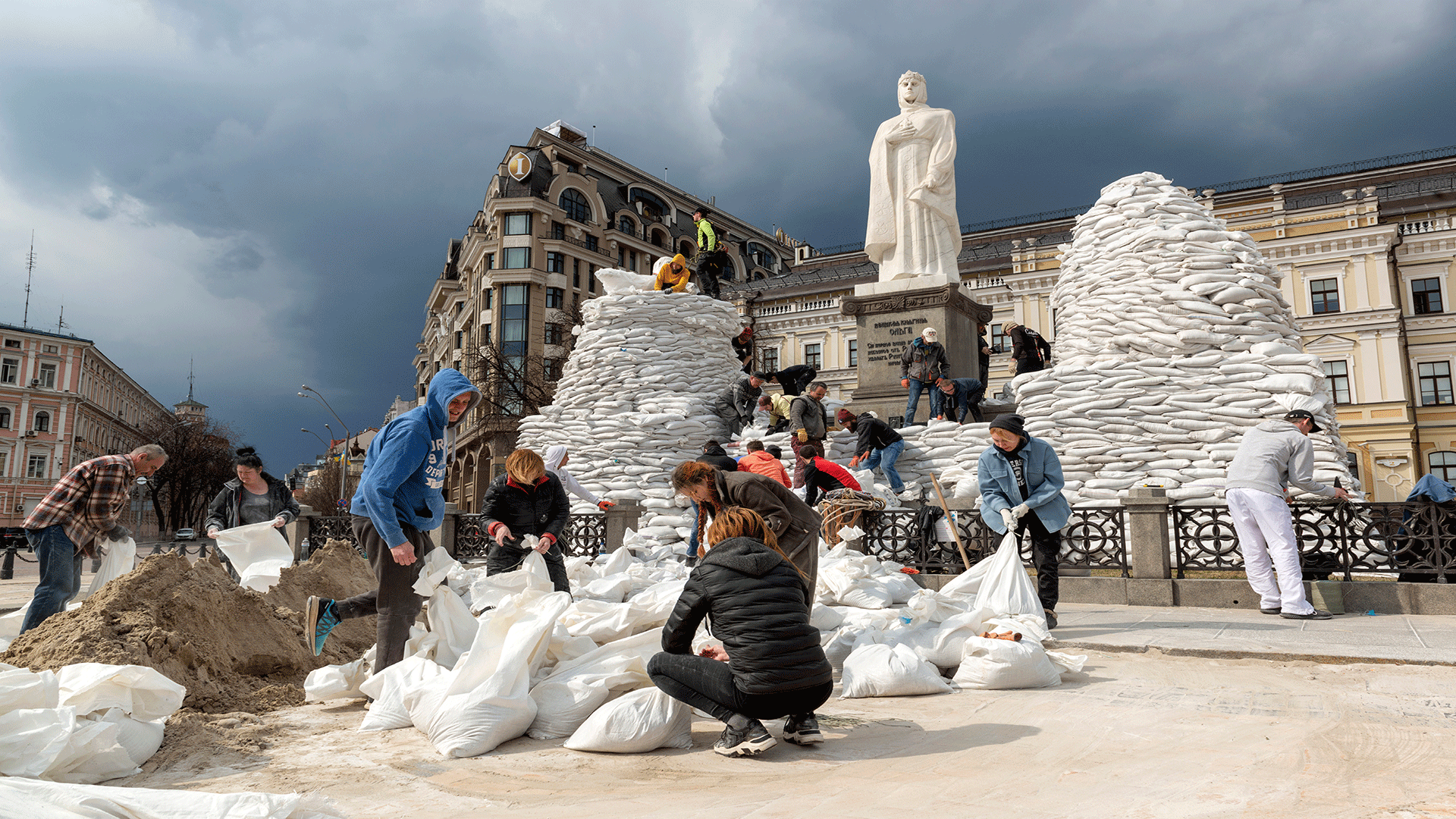
Ukraine has created a special legal framework to ensure security for cultural heritage sites during wartime. The Ministry of Culture and Strategic Communications of Ukraine is in charge of the implementation of state policy in the areas of protection of cultural heritage; museum affairs; export, import, and return of cultural values; and restoration and preservation of national memory. In the early days of the war, the Ministry’s main mission shifted to the development of preventive measures to preserve monuments and facilitate their evacuation to other places in Ukraine and abroad. Oleg Rishnyak, head of the Painting Restoration Department at the Ukrainian Regional Specialized Scientific and Restoration Institute, notes that, according to some estimates, this initiative constituted the largest movement of cultural property in Europe since World War II. (However, the details of these evacuation efforts have not been made public, making it difficult to verify such claims.)
Olga Honchar, director of the ‘Territory of Terror’ Memorial Museum of Totalitarian Regimes, noted in an interview with the National Public Broadcasting Company of Ukraine (Suspilne Ukraina) that “museum workers do not give up in war… this is what unites us.” Three years after the Russian invasion of Ukraine, Ukrainian institutions are working diligently to digitise cultural archives and find new safe places to store artifacts. Ukrainian state and regional archives are also actively cooperating with FamilySearch, a US nonprofit organisation offering genealogical records and software, to advance document digitisation. As of 2024, the State Archives of Rivne Region, has managed to digitise over 1.2 million pages of birth records through its cooperation with FamilySearch and other international partners.
At the same time, museum directors are looking for new ways to conduct their work amid the ongoing conflict. For example, Oksana Barshinova, deputy director general of the National Art Museum of Ukraine, chooses to emphasise the museum’s role as a forum: “This is a place for developing culture, a cultural field, a place of communication, where people come, where excursions, lectures, master classes, and meetings take place. This is especially important now, when the walls are empty.”
The war in Ukraine clearly highlights the susceptibility of cultural heritage sites during armed conflicts. To prevent the destruction of these sites, Ukraine is following the norms of international law and actively cooperating with international organizations. Although international legal mechanisms provide a framework for the protection of cultural heritage, their effectiveness remains conditional on state cooperation and the capacity of international institutions to respond to violations with urgency and determination. To address these limitations, it is essential to establish a comprehensive legal framework at the European level for the evacuation of cultural heritage artifacts in the event of armed conflict involving non-EU states. This mechanism would facilitate a unified and efficient response to the imperilment of cultural heritage during conflicts and provide a blueprint for protection of cultural heritage beyond the borders of the European Union.
Tags: Culture, cultural heritage, War, Protection, Ukraine