What’s at stake with Mercosur?
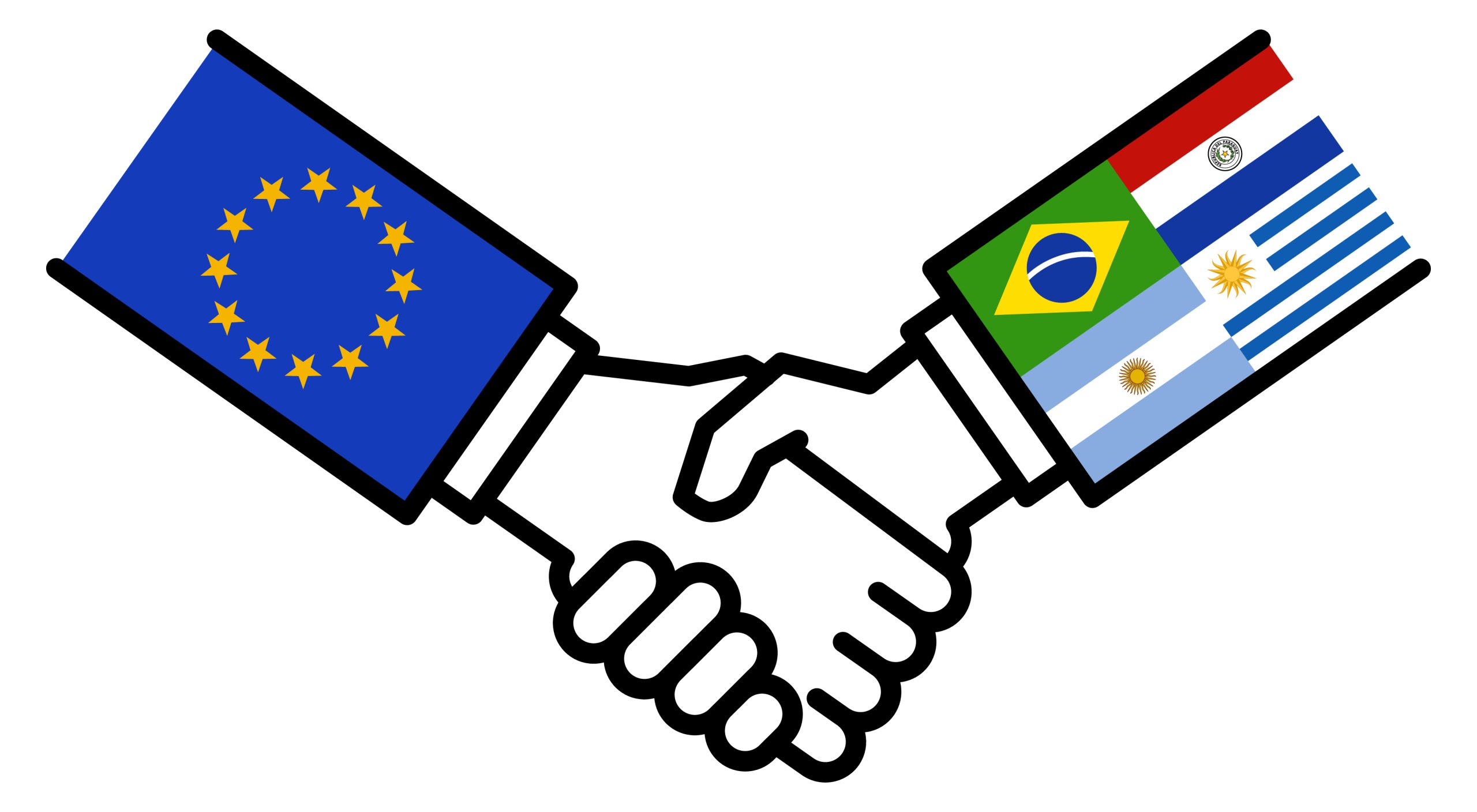
As Europe witnesses new rounds of talks between EU negotiators and Mercosur, sectors of its civil society question whether this agreement – a constant source of controversies –is in their best interest. Policy Leader Fellow Bruno Capuzzi argues that missing the opportunity to politically align with Mercosur would be symptomatic of a geopolitical myopia from the European side.
Author:

Reading time: 9 min.
As Europe witnesses new rounds of talks between EU negotiators and Mercosur (Argentina, Brazil, Paraguay, and Uruguay), parts of its civil society question whether it is their interest to close a long and dubious trade deal. A new momentum seems to be gaining traction towards a high-level meeting at the Mercosur summit in early December with an expected visit from the President of the European Commission, Ursula von der Leyen.
Farmers have been hitting the streets of Brussels in coordinated protests, condemning green policies for the sector and any attempt to connect the EU’s agrifood markets to what farming syndicates perceive as potential threats: from distant New Zealand and Australia, to the cold fields of Canada, to Mercosur’s Argentina and Brazil with their agricultural productivity. Similar fears about an oversupply of beef were spurred during negotiations with Canada (LesEchos; Food Navigator), but they did not materialise. After five years of provisional implementation of this agreement, which is fully applicable to the trade pillar, only 2% of the quota is used by Canadian exporters (Le Monde; ECIPE).
With Mercosur, an ‘agreement in principle’ was reached in 2019 for the trade pillar of a broader Association Agreement that aims to bring these two parts of the world closer together. That means that trade offers were accepted by negotiators and legal steps of ratification could take place: a vote in the European Parliament and by member states at the Council. However, demands from politics and society made it impossible to happen.
Far from being a sealed deal, the agreement has been a constant issue of controversies. Fears from Argentina and Brazil’s agricultural productivity were fuelled with environmental concerns on the European side. From Mercosur’s perspective, the offers needed to be rebalanced due to expected trade distortion effects of the EU’s recent unilateral trade measures, e.g., the EU Deforestation Regulation (EUDR) and the Carbon Border Adjustment Mechanism (CBAM).
I argue that, under global geopolitical tensions between East and West, missing the opportunity to be present and politically aligned with Mercosur is symptomatic of a geopolitical myopia from the European side. Fears of market disruptions from trade seems to be unfounded, as I aim to illustrate.
What’s the beef?
Non-consecutive negotiation rounds were prompted and frozen many times since 1999 due to the opposing interests and sensitivities from both the EU and Mercosur. In a nutshell, while the EU has an agricultural protectionist profile with quota restrictions on importing animal protein, dairy, sugar, and minimum import prices for some fruits and vegetables, these are the goods of greatest interest for Mercosur. On the other hand, Mercosur’s industrial sector has a relatively high tariff profile with protection reaching 20% for machinery and 35% for cars. These and other added-value industrial goods are among the main exporting interests for European economies.
Increasing geopolitical rivalries, such as the tariff clashes with the US and China, and the stagnant multilateral trade regime helped both parties to accept the offers on the table in 2019. Generally speaking, the agreement would eliminate 95% of EU import tariffs and 91% of Mercosur’s over a 10-year transition period. Nonetheless, while industrial tariffs would be completely slashed in Mercosur, some sensitive sectors in the EU will remain protected by quantitative quotas. To have a deeper view on the impacts and price relations in the cases of beef and poultry, check this other piece I co-authored at ECIPE (European Centre for International Political Economy).
A controversial Association Agreement (AA)
Trade is one of the three pillars that make up the controversial agreement, and it might not even be the most important one. The existing impact assessment by the European Commission is flawed for not considering the real results of the negotiation and simulating unrealistic scenarios. Nevertheless, the computable general equilibrium (CGE) model used (that can be disputed) anticipates modest (much less than 1%) gross domestic product (GDP) changes after 10 years of gradual trade liberalization.
The Association Agreement (AA) contains a political dialogue and cooperation chapter, with an extensive weight on areas such as (a) environment, climate change, and biodiversity; (b) digital development including cyber security, personal data protection, digital economy; (c) labour rights and corporate social responsibility; and (d) international cooperation on security and organised crime. As commented in this in-depth analysis commissioned by the European Parliament:
“These areas are key policy priorities for the EU, the success of which critically depends on an active global engagement, particularly with like-minded partners such as Mercosur countries.” (p. 7)
Political dialogue and cooperation will be continuously operationalised, which does not happen today, at different spheres: a) an Association Council (ministerial level); b) an Association Committee (senior official level); and c) Sub-Committees (technical level). This engagement could be a platform for the harmonisation of practices, regulations, and exchange of data. This could address outcome-based equivalences of policies and practices on environmental provisions in a pragmatic way, as I argue in a recent paper on how to make the EU Deforestation Regulation compatible with the World Trade Organisation (WTO). The role of civil society is also foreseen under the establishment of bi-regional Domestic Advisory Groups (DAGs) and the Civil Society Forum (CSF).
Rather than raising unilateral barriers, ratifying the agreement and establishing institutional political and societal channels is the best way for the EU to influence and exercise its intended leadership in environmental and social rights.
At what cost?
A major part of the EU’s imports from Mercosur is already fully liberalised. In 2023, 71% of everything Europeans consumed from the southern group already had 0% import tariffs. This is the case for soybeans and green coffee, essential for the productivity of the EU industry for local consumption and exports. For these commodities that make up a large part of the EU importing agenda, the agreement will not move the needle in terms of economic benefits or environmental threats.
As Oscar Guinea and I demonstrate, even in controversial cases such as beef and poultry, the changes might be de minimis. Trade benefits for Mercosur will represent less than two burgers (or two fish fillets) per EU citizen per year, failing to reach 2% of local consumption. What the EU demanded from Mercosur in 2023 was registered at higher prices than the local EU market output. This suggests that these imports are necessary to compose the consumption of premium cuts by Europeans that would not be possible otherwise. This is the case of bresaola della Valtellina, where local production would not meet one week of annual demand. In addition, only pre-authorised slaughterhouses can export to the EU after proving to be 100% in compliance with its rules and standards. Any potential demand push would have natural production bottlenecks of these operators.
Market for beef – EU consumption, Mercosur quota, and prices


Source: European Commission. EU agricultural outlook 2023-35. Figures 7 December 2023 (https://agriculture.ec.europa.eu/data-and-analysis/markets/outlook/medium-term_en); Import data (https://ec.europa.eu/eurostat/comext/newxtweb/) 2023
Geopolitics talk
Fukuyama’s “End of History” arguably ended on 11 September 2001 (Al Qaeda’s attack on the World Trade Center in New York) when the world embarked on a gradual paradigm shift. The then unquestioned western-liberal hegemony would increasingly be contested and bearing scars from the 2008 financial crisis. The so-called race-to-the-bottom that pushed industrialisation to Asia to sustain the cheap consumption growth model seems to be reshuffling as key actors reforge industrial and trade policies. Take, for example, the USA Inflation Reduction Act (IRA) and the EU’s Green Industrial Plan and funding through the NextGenerationEU. Not to mention pledges for near/reshoring claims and the controversial ‘strategic autonomy‘ concept.
In this context, the European Union needs to reassert its global presence straddled between trade giants: the US and China. With a decreasing share of the world’s GDP and trade (see Draghi and Letta reports), some argue the EU should not isolate itself. Supply chain resilience through diversification seems to be a better buffer to economic shocks than a crusade for self-sufficiency and reshoring (WTO Trade Report 2021; World Economic Forum), even for agricultural markets (FAO) and critical raw materials (ECIPE). With an ageing population and net losses of people in working age, the EU cannot afford to isolate itself economically risking jeopardizing its exporting agenda.
As Mercosur shares common languages, culture, and heritage with European partners, while having democratic institutions abiding by the rule of law, the EU seems to overlook its strategic presence in the region. However, the geopolitical chessboard is not unknown to the High Representative of the Union for Foreign Affairs and Security Policy when commenting on China’s 34-fold investment increase in Latin America between 2020 and 2022, or to other political actors and think tankers.
Is it a wrap?
In the inauguration of her first term, von der Leyen called for a geopolitical Commission. This Association Agreement is an opportunity to foster common governance in a cooperative and non-coercive way. Failing to do so would be a missed opportunity to promote European values and interests on the global stage, such as fostering environmental and human rights agendas. Modest trade increases will hardly be of enough magnitude to threaten environmental protection. In any case, an institutionalised scenario with the agreement holds a better chance to cooperate on a green agenda than otherwise.
Tags: Latin America, Global trade, Trade agreements, Agriculture, EU-LatAm